Livejournal is on a security vacation, so I'm posting the review of my Book #5 and links here. Book #4 was Catcher in the Rye which I released at the Culi Pub in Hanoi last week - still no takers. I'm not ready to post that review yet. So here, I'm writing about my new favorite book, which starts like this:
When the phone rang, I was in the kitchen, boiling a potful of spaghetti and whistling along to an FM broadcast of the overture to Rossini's 'The Thieving Magpie,' which has to be the perfect music for cooking pasta.
I wanted to ignore the phone, not only because the spaghetti was nearly done but because Claudio Abbado was bringing the Long Symphony to its musical climax. Finally, though, I had to give in. It could have been someone with news of a job. I turned down the gas, went to the living room, and picked up the receiver.
"Ten minutes, please," said a woman on the other end.
I'm good a recognizing people's voices, but this was not one I knew.
"Excuse me? To whom did you wish to speak?"
"To you, of course. Ten minutes, pleasse. That's all we need to understand each other."
And so begins The Wind-up Bird Chronicles, by Haruki Murkami. It is a mesmorizing book written in the first person, of the strange life of Toru Okada. It all starts when the cat disappears. Was that the cause of it all or just a point of reference? Searching for the cat leads him into a well, and into himself. In the middle of all this, his wife disappears. In order to find her, find the cat, and even to find himself, he meets strangers who are drawn to him. There's another world of meaning and explanations behind this one and the question is - is a dream or is it real?
I liked the quote on the process of Murakami's writing at the bottom.
Some links to Murakami sites:
Biography: http://en.wikipedia.org/wiki/Haruki_Murakami
Main "official" website: http://www.murakami.ch/main_2.html
The Year of Making Spaghetti, a short story: The Year of Making Spaghetti
Another short story: http://www.newyorker.com/fiction/content/articles/050926fi_fiction
Random House website (This is cute because the web page opens on to his new book Kafka on the Beach, and has cats walking back and forth at the bottom of the page): http://www.randomhouse.com/features/murakami/site.php?id=xml/books/kafka/about.xml
Interview at Salon, in which he talks about alienation, influence of the West, and how he is intrigued by writing genre fiction, particularly the form of mystery: http://www.salon.com/books/int/1997/12/cov_si_16int.html
New York Times Book Review: http://query.nytimes.com/gst/fullpage.html?res=9800EED9133EF931A35752C1A961958260
Quoted from the review:
''The Wind-Up Bird Chronicle'' does have its flaws, principally in its uneven design. Murakami has said that he does not plot his novels beforehand but lets the story reveal itself to him as he writes: it shows, especially in the way that neither Toru nor the novelist seems to know or care whether Toru's adventures are real or illusory. And the juxtaposition of the harrowing, all-too-real war stories with the marvelous, supernatural events in Toru's quest feels contrived. The war narratives were almost certainly composed separately and then inserted into the novel to support its grand aspirations.
Yet what Murakami lacks in finesse is more than compensated by the brilliance of his invention. As it floats to its conclusion, ''The Wind-Up Bird Chronicle'' includes an almost Joycean range of literary forms: flashbacks, dreams, letters, newspaper stories and transcripts of Internet chats. And no matter how fantastical the events it describes may be, the straight-ahead storytelling never loses its propulsive force. By the book's midway point, the novelist-juggler has tossed so many balls into the air that he inevitably misses a few on the way down. Visionary artists aren't always neat: who reads Kafka for his tight construction? In ''The Wind-Up Bird Chronicle'' Murakami has written a bold and generous book, and one that would have lost a great deal by being tidied up.
Saturday, January 28, 2006

Tuesday, November 29, 2005
Prompts from Daily Life
Walking around Bangkok is a prompt in itself:
Signages -
Massage parlor - "Thai Foot Aroma Oil Massage"
Restaurant - "Birds-eye View Eating-house."
Rental apartment - "Fully Furnitured."
Tailor - "The Bespoke Tailoring"
There are so many more. For fifteen years, I've been telling myself to remember to write them down, but if I have bags in my arms, it's difficult. It's like I've always wanted to get a picture of six on a motorcycle - there they go, down the soi - father driving with a kid balanced between his thighs, mother sitting sideways, baby in arm and two kids squeezed between her hip and the father's back. Never have a camera ready at those times, never.
Signages -
Massage parlor - "Thai Foot Aroma Oil Massage"
Restaurant - "Birds-eye View Eating-house."
Rental apartment - "Fully Furnitured."
Tailor - "The Bespoke Tailoring"
There are so many more. For fifteen years, I've been telling myself to remember to write them down, but if I have bags in my arms, it's difficult. It's like I've always wanted to get a picture of six on a motorcycle - there they go, down the soi - father driving with a kid balanced between his thighs, mother sitting sideways, baby in arm and two kids squeezed between her hip and the father's back. Never have a camera ready at those times, never.
Monday, November 21, 2005
A long time since the last time...
Haven't been posting very often here, but I'm still alive, still living in Laos. Took a trip to the US during October and spent some time in the Eastern part of the country - Boston, Chicago, Atlanta, NYC, upstate NY and then left from Boston. Although I grew up in New York, I spent most of my last years in the US on the West coast and whenever I go to visit the US, I usually land in Seattle, and head down the coast, crashing into Merced before I bounce back up to Seattle in time to catch the plane back here.
I missed the boat racing festival, not only for Vientiane but also for my village. It's fun when it happens but the build up is kinda agonizing - during the final month before the Big Event, there are many Bouns in the temples, big merit-making ceremonies. At the same time, the villages along the river have their races to select the boats for the race in Vientiane. These are accompanied by a lot of drinking and traffic accidents. That's not fun.
For those who follow the weather, it is now the dust season - a cold wind comes from the north. The mornings are cold and foggy and once the sky clears, it's an incredible shade of blue. It may seem strange that it would get cold in a tropical country but the temperatures can get below freezing in Xieng Khouang, and considering that there's no indoor heating, that can feel pretty cold.
I missed the boat racing festival, not only for Vientiane but also for my village. It's fun when it happens but the build up is kinda agonizing - during the final month before the Big Event, there are many Bouns in the temples, big merit-making ceremonies. At the same time, the villages along the river have their races to select the boats for the race in Vientiane. These are accompanied by a lot of drinking and traffic accidents. That's not fun.
For those who follow the weather, it is now the dust season - a cold wind comes from the north. The mornings are cold and foggy and once the sky clears, it's an incredible shade of blue. It may seem strange that it would get cold in a tropical country but the temperatures can get below freezing in Xieng Khouang, and considering that there's no indoor heating, that can feel pretty cold.
Saturday, October 08, 2005
Landmines Conference
I noticed that I haven't posted for quite a while. I've mostly been writing on my Livejournal pages where my daily journals are on public access. I also have stories and stories fragments on my friends list.
I've been in the US for a week, which has been useful. I worked at my home office for a few days in Boston but have been in Chicago since Weds. I've been attending a conference on landmines.
My next stop is Atlanta, followed by New York, then returning to Boston before returning home.
I've been in the US for a week, which has been useful. I worked at my home office for a few days in Boston but have been in Chicago since Weds. I've been attending a conference on landmines.
My next stop is Atlanta, followed by New York, then returning to Boston before returning home.
Wednesday, August 10, 2005
Some photos
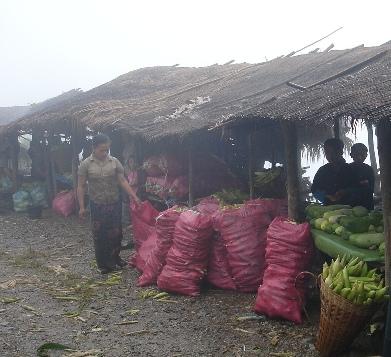

We returned from Xieng Khouang on 31 July, a drizzly cool day in the mountains. Mists streaming through the peaks, like a river of air. We stopped at a Hmong mini-mart to buy corn and cucumbers, not only the special of the day, but the only things they were selling that day. The Hmong are mountain people, and prefer to live along the sharpest ridges which have the most spectacular views, and with the solidity of the mountain behind them. Sometimes, the view isn't so great.
Tuesday, August 09, 2005
Rainy Season Doldrums
At the end of the hot season we all wished for rain to break the relentless heat. Now, we're experiencing the relentless gray and rain of the monsoons. The Mekong surged during the week I was up in Xieng Khouang. When I returned, it looked like it had moved up the side of the levee by about two meters. The water looked like a brown liquid metal as it slid past, carrying trees, styrofoam, and things we don't want to know about in plastic bags.
But the rain. I feel lazy when it's time to wake up and the water is pounding on the roof. The clothes on the line are lazy to dry. I would like to ride my bicycle but I'm lazy to get wet.
This is also the season called khao phansaa, the Buddhist Lent. Monks are supposed to return to their home temples and not to travel around. In the past, monks often went on pilgramages where they set up a small mosquito net tent in the field, and talked to the villages, giving teaching and also learning about the hardships. In the monsoon season, they are supposed to stay in the temple and focus on learning and memorizing the scriptures. Another reason for the monks to do this is that they avoid stepping on the life that is re-emerging from the mud such as snakes, eels or frogs.
For Buddhists, the monsoon season is the time to attend to the crops. Also, people are supposed to be reflective and to follow the ha sinh, the Five Precepts - try to avoid drinking, telling untruths, sexual misconduct, killing or stealing. During this time, one should not have loud parties or weddings - and if someone has a wedding, everyone avoids mentioning that it is an emergency situation.
Anyway, at my office, we are being good this year - no alcohol. A group of us is trying to lose weight. Another group is supposed to organize Friday afternoon games for motivation. We're trying to get people to pledge money to motivate the people in these groups - the pledges will go towards our fund for the medical care of people injured by unexploded ordnance (UXO). And if the groups don't make their goals, at the end of the three months, the members of the group will donate money into the UXO patients fund.
Anyway, it's what we call "Fun Raising."
But the rain. I feel lazy when it's time to wake up and the water is pounding on the roof. The clothes on the line are lazy to dry. I would like to ride my bicycle but I'm lazy to get wet.
This is also the season called khao phansaa, the Buddhist Lent. Monks are supposed to return to their home temples and not to travel around. In the past, monks often went on pilgramages where they set up a small mosquito net tent in the field, and talked to the villages, giving teaching and also learning about the hardships. In the monsoon season, they are supposed to stay in the temple and focus on learning and memorizing the scriptures. Another reason for the monks to do this is that they avoid stepping on the life that is re-emerging from the mud such as snakes, eels or frogs.
For Buddhists, the monsoon season is the time to attend to the crops. Also, people are supposed to be reflective and to follow the ha sinh, the Five Precepts - try to avoid drinking, telling untruths, sexual misconduct, killing or stealing. During this time, one should not have loud parties or weddings - and if someone has a wedding, everyone avoids mentioning that it is an emergency situation.
Anyway, at my office, we are being good this year - no alcohol. A group of us is trying to lose weight. Another group is supposed to organize Friday afternoon games for motivation. We're trying to get people to pledge money to motivate the people in these groups - the pledges will go towards our fund for the medical care of people injured by unexploded ordnance (UXO). And if the groups don't make their goals, at the end of the three months, the members of the group will donate money into the UXO patients fund.
Anyway, it's what we call "Fun Raising."
Tuesday, July 12, 2005
Back again?
What's the story? The Flying Dutchman, where the ghost ship appears and disappears and then reappears? So I guess I should rename this blog the Flying Blogman. I don't have much to say that I haven't already written in the Mekong River Reviews, so I'll just upload some recent pictures.
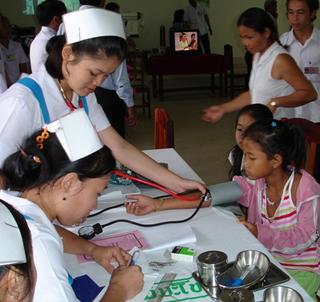
Lao people are becoming more interested in health, as public health improves and the average life expectancy rises. Recently, the National Rehabilitation Center had a health fair, and a lot of folks came for the music provided by the students at the School for the Blind, the handicrafts sale, and for basic health checks and health information. It was fun as well as useful.
Lao people are becoming more interested in health, as public health improves and the average life expectancy rises. Recently, the National Rehabilitation Center had a health fair, and a lot of folks came for the music provided by the students at the School for the Blind, the handicrafts sale, and for basic health checks and health information. It was fun as well as useful.
Monday, June 13, 2005
Visible again
OK, so things seem to be working again. The road crew blocked my road into my house because they finally put the coat of tar down. My cat already gave birth to 3 orange kittens by the time I got home, alleviating my fear that she would give birth in a neighbor's attic and then get locked out (happened with the last set of kittens). My paraplegic patient may have decided to accept vocational training. And Blogger seems to be working now.
Some of the other links that I like on Blogger, which I can now view:
No Star Where - about the life of an expatriate in Vietnam: http://nostarwhere.blogspot.com
Linksaplenty - where to go if you need to look at something new to stimulate your mind, writing, or whatever: http://linksaplenty.blogspot.com
That's enough for now. My alternative blog is:
Mekong River Review
Some of the other links that I like on Blogger, which I can now view:
No Star Where - about the life of an expatriate in Vietnam: http://nostarwhere.blogspot.com
Linksaplenty - where to go if you need to look at something new to stimulate your mind, writing, or whatever: http://linksaplenty.blogspot.com
That's enough for now. My alternative blog is:
Mekong River Review
Monday, June 06, 2005
Hot Times
I finished my first exam today. I feel better already. Health management on Wednesday, and then I can return to worrying about the other things in my life. Will my pregnant cat have her kittens in an appropriate location (not in a neighbor's attic)? Will the village ever finish the paving of the side streets (they started after the rains started so they are often working in knee deep muck)? When we will be able to start work on the new project? Oh, the list goes on.
Right now, the sky is clearing. After the test, I sat by the pool for a while, then as I was riding my bicycle home, the sky opened up. I ducked into an internet cafe for an hour until the rain stopped and the mists started to rise from the pavement. Now the sky is clearing and the sun's starting its descent to the west. The Mekong is brown and flat.
Right now, the sky is clearing. After the test, I sat by the pool for a while, then as I was riding my bicycle home, the sky opened up. I ducked into an internet cafe for an hour until the rain stopped and the mists started to rise from the pavement. Now the sky is clearing and the sun's starting its descent to the west. The Mekong is brown and flat.
Saturday, June 04, 2005
Health Systems Management
When I visited my old clinic in California, my former colleagues thought I had gone bonkers. I told them that I was working on my Master's degree in 'Health Systems Management.' I have to admit that I agree with them; when we worked together, I just hated the whole concept. I considered myself to be a clinician - willing to work overtime to see more patients, leave my day job to drive an hour to make sure the homeless clinic had a medical provider, set up health clinics at migrant farmworker camps, etc. When we had discussions about financing, quality assurance, and cost-benefit analysis, I went to sleep; it never seemed relevant to me.
Since I've been working in Laos, health systems management has grown in importance for me. I realized - quickly - that if I train medical staff in some skill, and then they can not use this skill, then it's as if they never had the training at all. However, when we have planning meetings, medical staff usually say that they need medical training, and don't address other issues.
An example: One day, in 1998, I was talking with a lab technician in a district hospital. I asked her how many Gram stains they were doing (a staining procedure so you can see bacteria to determine if they are Gram + or Gram - so you can start the decision tree about the probable causitive organism). She said that they didn't do any because she didn't have the chemicals. I remembered giving them a set of premixed chemicals and after rummaging in the cabinet, I pulled it out (unopened!). She then sheepishly admitted that although she knew how to do the procedure, and had the chemicals, the doctors were not ordering it. This led to other discussions that involved changing habits (doctors were not accustomed to ordering other tests because they didn't have the opportunities before) to advocating to patients about the need for the tests to guide treatment.
I quickly realized that upgrading medical treatment is very complex. So to pick up the skills to make the changes in behavior sustainable, I've been working my way through this program.
So next week, I'm taking the exams in Health Economics and Financing and Health Management. For the past few weeks, after studying for an hour, I've been rewarding myself with a half hour of writing. I'm trying to do the same thing this weekend.
Since I've been working in Laos, health systems management has grown in importance for me. I realized - quickly - that if I train medical staff in some skill, and then they can not use this skill, then it's as if they never had the training at all. However, when we have planning meetings, medical staff usually say that they need medical training, and don't address other issues.
An example: One day, in 1998, I was talking with a lab technician in a district hospital. I asked her how many Gram stains they were doing (a staining procedure so you can see bacteria to determine if they are Gram + or Gram - so you can start the decision tree about the probable causitive organism). She said that they didn't do any because she didn't have the chemicals. I remembered giving them a set of premixed chemicals and after rummaging in the cabinet, I pulled it out (unopened!). She then sheepishly admitted that although she knew how to do the procedure, and had the chemicals, the doctors were not ordering it. This led to other discussions that involved changing habits (doctors were not accustomed to ordering other tests because they didn't have the opportunities before) to advocating to patients about the need for the tests to guide treatment.
I quickly realized that upgrading medical treatment is very complex. So to pick up the skills to make the changes in behavior sustainable, I've been working my way through this program.
So next week, I'm taking the exams in Health Economics and Financing and Health Management. For the past few weeks, after studying for an hour, I've been rewarding myself with a half hour of writing. I'm trying to do the same thing this weekend.
Saturday, May 14, 2005
Paraskevidekatriaphobia
With all my pictures on the sending of good luck for Lao new year, I forgot yesterday's date. I guess that shows how concerned I was about it.
http://skepdic.com/paraskevidekatriaphobia.html has an interesting set of articles on Friday the 13th, starting off with the following:
"Paraskevidekatriaphobia is a morbid, irrational fear of Friday the 13th. Therapist Dr. Donald Dossey, whose specialty is treating people with irrational fears, coined the term. He claims that when you can pronounce the word you are cured."
Nothing unusual happened yesterday, other than I was able to find time to update my blogs and write some. Of course, as I write this, it's still Friday the 13th in the US!
http://skepdic.com/paraskevidekatriaphobia.html has an interesting set of articles on Friday the 13th, starting off with the following:
"Paraskevidekatriaphobia is a morbid, irrational fear of Friday the 13th. Therapist Dr. Donald Dossey, whose specialty is treating people with irrational fears, coined the term. He claims that when you can pronounce the word you are cured."
Nothing unusual happened yesterday, other than I was able to find time to update my blogs and write some. Of course, as I write this, it's still Friday the 13th in the US!
Friday, May 13, 2005



Wednesday, April 20, 2005
4 Baci ceremonies and a funeral
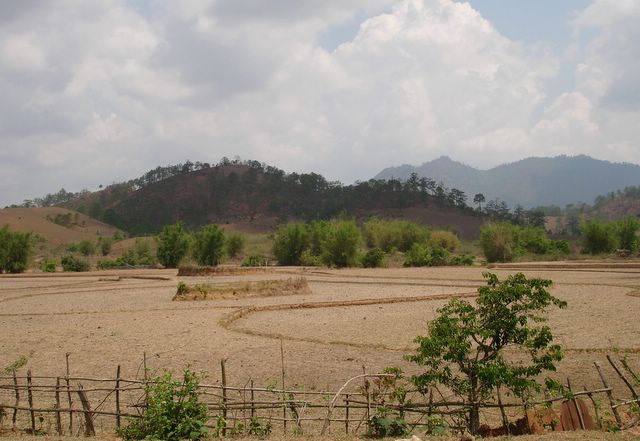
The Lao new year started on 7 April and finished on the 19th. The way to celebrate the new year is to visit, go to a lot of parties, and go to Baci ceremonies. It was entirely too hot to stay in Vientiane, so I went up to Xieng Khouang. The elevation of Phonsavanh, the capital, is about 4,000 ft. so the weather is cooler, drier and breezy.
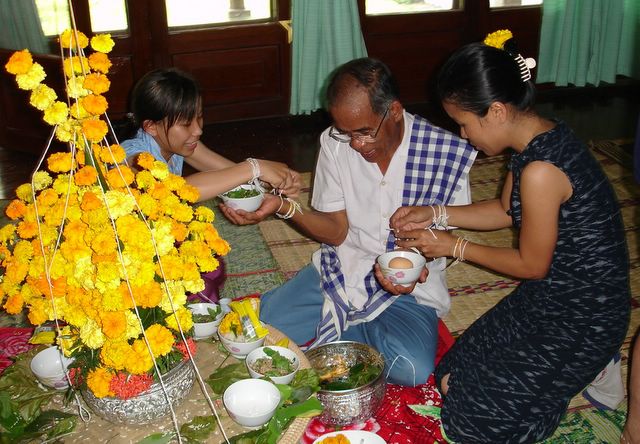
I arrived on Friday after enjoying a few baci ceremonies in Vientiane. These ceremonies are done at various times of the year for a variety of reasons. The purpose of having a Baci is to call back the minor souls of the body. Depending on who you talk to, there can be three (which includes the spirts of the body, the mind and the emotions) or as many as 32 (one for each of the sense organs and etc.; I've never been able to track down a full list). For various life events, you need to hold onto your souls (weddings, after an illness, arrival to a place, departures, moving to a new house, etc.). In addition, ceremonies for the new years (which starts in December with the international new year, continues through the new year of the Chinese, Tai Dam, Vietnamese and Mien, and then finishes with the Lao/ Thai/ Khmer new years in April) are times to "get off the bad luck and welcome in the good luck."
For most of the ceremonies the schedule is similar. The Mor Phone (wish doctor) recites Buddhist prayers, might recite a fable or a story about one of the past lives of the Buddha and recites good wishes for the person who is having the Baci as a way of enticing the souls to return. This is followed by a free-for-all while all the guests tie strings on each other, bestowing wishes on each other, both normal and outrageous. Fruits or cakes are placed in one of the hands of the recipiant while the other is held in a wei-position of giving thanks. The Lao like to use two oranges (or two eggs) and a banana (go figger).
I was finishing the review of a grant proposal at about midnight, when I started to hear weird noises outside my house. Later, I heard a car at my neighbors. My neighborhood in XK is quiet. The following morning I learned that a doctor I've worked with over the past eight years had been run over by a drunk teenager on a motorcycle. That made the rest of the holiday very sad, though it made myself and all my friends appreciate our time together.
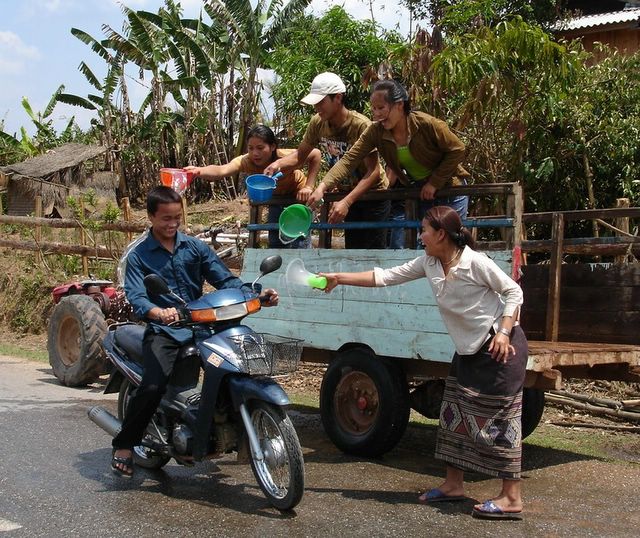
For the rest of the holiday, we went to visit friends in Phoukout, in the western part of the province. My friends' relatives emptied their fish pound so we had a feast of grilled fish. The kids enjoyed themselves by throwing water on everyone, including people driving on the road.
The water throwing comes from the idea of washing away the bad of the past year while purifying oneself for the good of the new year. It usually starts gradually, with a young person pouring a few drops of the blessing water, used by the Mor Phone during the Baci ceremony, down the backs of the elder people or over their hands. As the heat of the afternoons wears on, everyone throws water on each other.
In the evening, my neighbors had another Baci. Since so many people return to their home towns during the new year, the Mor Phone conducts part of the ceremony in the kitchen or in the house using the sticky rice steamer as the symbol for the hearth.
The following morning, there was - you guessed it - another Baci ceremony at a friend's mother's house. That was enough, I had strings tied up to my elbows on both arms (they have to be left on for three days, then you can start picking them off, but they have to be untied, not cut).
At the end of the weekend, I went to visit my deceased friend's wife. That was very sad. I couldn't stay for the final day of the funeral and the cremation.
The following two sites tell a little bit about the ceremony and have pictures.
http://www.lib.uci.edu/libraries/collections/sea/seaexhibit/laoam.html
http://www.savannanet.com/baci.htm
Chanpheng
I arrived on Friday after enjoying a few baci ceremonies in Vientiane. These ceremonies are done at various times of the year for a variety of reasons. The purpose of having a Baci is to call back the minor souls of the body. Depending on who you talk to, there can be three (which includes the spirts of the body, the mind and the emotions) or as many as 32 (one for each of the sense organs and etc.; I've never been able to track down a full list). For various life events, you need to hold onto your souls (weddings, after an illness, arrival to a place, departures, moving to a new house, etc.). In addition, ceremonies for the new years (which starts in December with the international new year, continues through the new year of the Chinese, Tai Dam, Vietnamese and Mien, and then finishes with the Lao/ Thai/ Khmer new years in April) are times to "get off the bad luck and welcome in the good luck."
For most of the ceremonies the schedule is similar. The Mor Phone (wish doctor) recites Buddhist prayers, might recite a fable or a story about one of the past lives of the Buddha and recites good wishes for the person who is having the Baci as a way of enticing the souls to return. This is followed by a free-for-all while all the guests tie strings on each other, bestowing wishes on each other, both normal and outrageous. Fruits or cakes are placed in one of the hands of the recipiant while the other is held in a wei-position of giving thanks. The Lao like to use two oranges (or two eggs) and a banana (go figger).
I was finishing the review of a grant proposal at about midnight, when I started to hear weird noises outside my house. Later, I heard a car at my neighbors. My neighborhood in XK is quiet. The following morning I learned that a doctor I've worked with over the past eight years had been run over by a drunk teenager on a motorcycle. That made the rest of the holiday very sad, though it made myself and all my friends appreciate our time together.
For the rest of the holiday, we went to visit friends in Phoukout, in the western part of the province. My friends' relatives emptied their fish pound so we had a feast of grilled fish. The kids enjoyed themselves by throwing water on everyone, including people driving on the road.
The water throwing comes from the idea of washing away the bad of the past year while purifying oneself for the good of the new year. It usually starts gradually, with a young person pouring a few drops of the blessing water, used by the Mor Phone during the Baci ceremony, down the backs of the elder people or over their hands. As the heat of the afternoons wears on, everyone throws water on each other.
In the evening, my neighbors had another Baci. Since so many people return to their home towns during the new year, the Mor Phone conducts part of the ceremony in the kitchen or in the house using the sticky rice steamer as the symbol for the hearth.
The following morning, there was - you guessed it - another Baci ceremony at a friend's mother's house. That was enough, I had strings tied up to my elbows on both arms (they have to be left on for three days, then you can start picking them off, but they have to be untied, not cut).
At the end of the weekend, I went to visit my deceased friend's wife. That was very sad. I couldn't stay for the final day of the funeral and the cremation.
The following two sites tell a little bit about the ceremony and have pictures.
http://www.lib.uci.edu/libraries/collections/sea/seaexhibit/laoam.html
http://www.savannanet.com/baci.htm
Chanpheng
Friday, April 15, 2005
Lao New Year - still!
Lao New Year officially started yesterday. In the morning, people walked to the wat to offer food to the monks then wash the cheddhi housing the ashes of deceased relatives. Many people have Baci (string tying ceremonies) in the late morning. That's when the fun (?) begins - haut nam meaning throwing water, using the same word for watering plants. It usually starts with using a tree branch and flowers to dip in perfumed water and sprinkled on the guests for wishing of good luck. Later, one pours a little bit of water down the back of a guest's shirt and rubs the back of the shirt to rub in the good luck. Just a little bit later (and just a little bit more alcohol later), the container with the perfumed water gets dumped on someone's head. That's the signal to pull out water pistols, complicated Flash Gordon-style water canons and hoses for a free for all. Everyone gets drenched. The next step after that is to take the water fights to the street.
Yesterday, I drove home from the office and cut down a side street. Some kids stood in the middle of the road. I stopped and one young lady asked if she could give a small water offering. So she patted some water and perfumed talcum powder on my face. Another girl joined her and did the same. I didn't notice that a third person snuck up behind them until a whole basin-full of water entered the truck. Agghhh.
As I drove back to the office today, parties of drunk kids of all ages were throwing water all along the Luang Prabang road. My plan was to leave the truck then take a tuk-tuk, a small open sided motorized vehicle, back to the airport. I realized that the water fighting was not a good thing for my computer, so I called a friend who was making the circuit of parties and temples. So I ended up at the airport three hours early - but dry. I sat, drank a beer and wrote, even got in two hours of editing.
It's lovely up in Xieng Khouang now. The sky is clear, the stars are out and I'm happy to be in my little house. The kids are doing an amazing job with planting all sorts of flowers around the house. And I was relieved to find that Khamdee had not cut down the big trees behind the house, just trimmed back the branches a little.
Yesterday, I drove home from the office and cut down a side street. Some kids stood in the middle of the road. I stopped and one young lady asked if she could give a small water offering. So she patted some water and perfumed talcum powder on my face. Another girl joined her and did the same. I didn't notice that a third person snuck up behind them until a whole basin-full of water entered the truck. Agghhh.
As I drove back to the office today, parties of drunk kids of all ages were throwing water all along the Luang Prabang road. My plan was to leave the truck then take a tuk-tuk, a small open sided motorized vehicle, back to the airport. I realized that the water fighting was not a good thing for my computer, so I called a friend who was making the circuit of parties and temples. So I ended up at the airport three hours early - but dry. I sat, drank a beer and wrote, even got in two hours of editing.
It's lovely up in Xieng Khouang now. The sky is clear, the stars are out and I'm happy to be in my little house. The kids are doing an amazing job with planting all sorts of flowers around the house. And I was relieved to find that Khamdee had not cut down the big trees behind the house, just trimmed back the branches a little.
Friday, April 08, 2005
Lao New Year
Although Lao New Year doesn't start - officially - until 14 April, everyone's in party mode right now. Last night there was a party. I went to a party at Friendship Hospital today, and my calender is getting marked up with all the events which will be occurring over the weekend.
Anyway, Sok Dee Phii Mai (good luck in the new year!)
I've got to spend some time rememorizing the new year song.
Anyway, Sok Dee Phii Mai (good luck in the new year!)
I've got to spend some time rememorizing the new year song.
Tuesday, April 05, 2005

Subscribe to:
Posts (Atom)