It's difficult to believe, but it's been three years since the tsunami tore apart lives all through Asia, Indian costal cities and even spread to parts of Africa. Us modern people forget that whatever we do to warp the environment, the world's climate and politics, nature can take over and wipe everything out.
While life has returned to normal in most places, there are still wounds.
And people have forgotten. Maybe that's good, it can be a sign of recovery, returning to 'normal.' When I meet tourists who have visited Phuket, the resort area in Thailand that was severely hurt by the tsunami, I ask them what it's like now. They often stare at me blankly, not realizing the scope of the devastation just a few years ago. I haven't had a chance to go down there, though I've looked at the web site of the Chamber of Commerce, which emphasizes that the beaches, and the services that support going to the beach, are all back to normal.
One of my friends used to work with an NGO in Aceh, the province in the northern tip of Sumatra, where she had trained many health care and education staff. When she was able to get in contact with her old staff members, she learned that, by luck, some people had been visiting families or had been out of town on that day. Other people were not so lucky. Along with the 300,000 estimated deaths during that time, there are also the indirect impacts of natural disasters, which last much longer. Teachers who died leave students with knowledge, doctors who died leave a health care gap. Parents who die leave orphans who will always have a hole in their beings.
What happens after that? A crisis can be devastating, or can spur communities to pull together and help everyone. In the aftermath of the tsunami, there have been spots which have one response and places with other.
In other news, the World Bank has a report about its assistance together for Sri Lanka. The amount that it provided - 150 million USD is modest but seems to have made an impact. On the web site, it mentions that there are still 15,000 people who still need homes, but this will take more funding. There are also human interest stories that show the human impact of this natural disaster.
A lot of people have not yet received assistance though, even now. Although there was a great outpouring of aid throughout the region, local people often did not see the results. There were 'bottle necks,' where the funds were available but between local capacity (limited number of construction workers to rebuild houses) and logistics (lack of vehicles to transport supplies), people have been waiting for their lives to return to normal.
Some links:
Indonesia, Thailand mark Tsunami with Prayers
Asia Marks Anniversary
World Bank Support to Sri Lanka
Wednesday, December 26, 2007

Tuesday, December 25, 2007
Merry Christmas
Christmas was a quiet and thoughtful day. My Lao friends from all over the country called me. Christmas is not a public holiday so most of my friends were working. I could hear the children in the school behind me house as they shouted out their drills on the alphabet, and their happy shouts during recess.
I walked down to the office in the morning and rode my bicycle back home on the river road, then cutting inland for a tour of the rice fields. Farmers flooded some fields and have started the dry season rice farming.
I walked down to the office in the morning and rode my bicycle back home on the river road, then cutting inland for a tour of the rice fields. Farmers flooded some fields and have started the dry season rice farming.

This is my one Christmas photo. I'm not sure what the story is behind these offerings. Was someone killed here? Or is this a site that has traditionally be a place to make offerings to the spirits of the place? There are always offerings here - whether several bottles of Pepsi or a line of shot glasses filled with rice whiskey next to balls of sticky rice.
Monday, December 24, 2007
Christmas Eve
I always bring my camera around with me. All locations in Lao are photogenic. I was walking back to get my bicycle from the repair shop this afternoon when I saw these monks walking towards me. All Vientiane roads used to be lined with these big trees - though many have been cut down. Many are diseased but many have to make way for the new road building projects.
People used to wonder about why trees in Asia are painted white. Some people speculated that it's to prevent beetles from getting into the tree at their bases. But most people laugh and saw - the color prevents vehicles from crashing into them, especially during the time when there were no street lights.

Some other scenes around Vientiane:
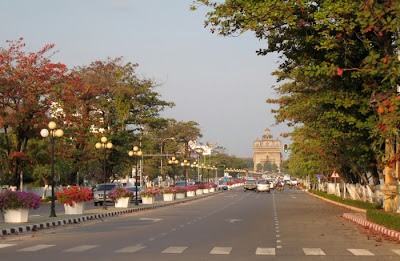
While the Pratuxay - the victory door - is similar in structure with its French cousin, the bas relief molded around the structure are all Lao images. This view is taken in the late afternoon, looking up Lane Xang Avenue.

After taking the overnight bus to Vientiane, I spent the day trying to stay awake at the office. There were a lot of little things to take care of, so the morning slipped away with phone calls. Organized a meeting for later in the week, got information on activities from four provinces for my quarterly reports, received an evaluation report. Etc and etc. Very productive, but I had planned to go up to Xieng Khouang for Christmas but the planes were full and I didn't want to spend Christmas Day on a ten-hour bus ride.
I took my bicycle for an overhaul. When I returned in the afternoon, I sat with the shop owner, who told me about how she and her family, although Buddhist, had gone to Christmas activities at various churches in the past. "They would have singing or skits, give out gifts and have food."
My own staff in Salavan plan to have a Christmas party with our counterparts.
Some other scenes around Vientiane:
While the Pratuxay - the victory door - is similar in structure with its French cousin, the bas relief molded around the structure are all Lao images. This view is taken in the late afternoon, looking up Lane Xang Avenue.
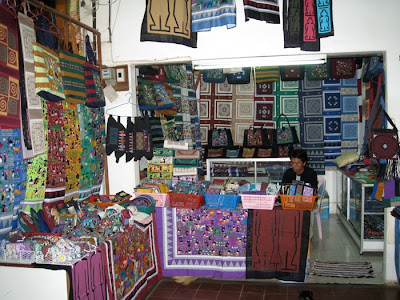
During lunch time, I stopped by the old Talad Sao, the morning market. Although the outside of the buildings look old, they were constructed about 13 years ago. Now, with progress, a new mall is going up next to the old market. Those vendors who can afford the rents, have been moving to the new building, which has air conditioning and fancier stores. The old market continues to function, with a section for silk and traditional handicrafts, another section for household items such as washing machines and flat-screen TVs, and food stalls. This market below sells Hmong embroidery and applique and is pretty typical of the stalls in the market.
Sunday, December 23, 2007
Sunday morning bicycle ride

I woke up early, while the sky was still dark. While sipping coffee, I watched the raising sun mold the shapes around Phou Ka-tae. I went out on my bicycle before the sun got up to full speed and went to survey the changes that the seasons were making near Salavan.
I left the main road at Na Khoy Sao Village. Although everyone laughs when they say the name, which means 'the rice field waiting for girls,' no one can tell me the history of the name. Did the men come first and they had to wait for their wives? Did they send for women once the fields were opened up? Was it an old military camp during the 'Vietnam' War? I could speculate on and on.
While the dry season is easier for bicycling - didn't get stuck in mud at least - the dust can be just as bad. This fine material can be several inches thick and it's difficult for pedaling. And if a car or motorcycle goes by, it stirs up the dust so that I can't see for several minutes. I took this picture of a herd of buffalo a farmer had just released so they could forage for the day.
There are always interesting vehicles crowding the roads - two-wheeled tractors pulling trailers packed with families and neighbors going to town for the day, motorcycles pulling handcarts, with the passenger sitting on the cross-bar of the cart, or motorcycle vendors, like those below. They are mostly Vietnamese vendors who stock up and go to the most remote areas to sell their wares. Rural people rely on them for buying pots and pans, new clothes, or motorcycle batteries which they can use to power a small light bulb.

Saturday, December 22, 2007
You would think...
After all the worrying about whether the team got to Salavan, which was not relieved by calling their cell phones because they were turned off, you think that my staff would have the consideration to call me when they returned to town. Forget it! They got back at 3 and finally answered when I called them at 7 pm. The original plan was to have dinner before our guests returned to Vientiane; however, they had left just after returning from the district.
I've worked with one of these people for seven years, the other for three years. You would think...
Never mind.
Grump.
I've worked with one of these people for seven years, the other for three years. You would think...
Never mind.
Grump.
Saturday at the office
In spite of the designation of "cold season," the weather in Salavan has not cooled. It must be about 30 degrees C outside; my house collects the heat so it's probably about 35 degrees C inside. The sun beats down on the roofs of the houses, already covered with dust. The world can look gray though in the distance, the mountains stand out clearly.
It's quiet at the office, except for ambient sounds from other areas of the hospital. Earlier, I heard the distinctive cry of a new born - we're right above the delivery room. A couple of people stick their heads in through the open door, looking for the place where they get get their health exams signed for their drivers licenses.
This morning, my neighbor's daughter stopped by, with two gigantic fresh coconuts, which had just fallen off the tree in front of my house. The coconut juice was so sweet and the coconut meat was the highlight of my breakfast.
It's quiet at the office, except for ambient sounds from other areas of the hospital. Earlier, I heard the distinctive cry of a new born - we're right above the delivery room. A couple of people stick their heads in through the open door, looking for the place where they get get their health exams signed for their drivers licenses.
This morning, my neighbor's daughter stopped by, with two gigantic fresh coconuts, which had just fallen off the tree in front of my house. The coconut juice was so sweet and the coconut meat was the highlight of my breakfast.
Friday, December 21, 2007
It all turns out all right in the end
Yesterday, I was perturbed because we had difficulty coordinating vehicles. It meant that instead of taking two trucks, with some technicians, I got left behind and the techs will go next week. I hadn't been out to this remote district for a while, so I was looking forward to the trip, even if it meant an eight hour trip, including the lunch stop.
At the end of the afternoon, I found out that our truck got stuck behind another truck that had broken down, blocking trucks in both directions. I substituted my feelings of disappointment with worry. I hope they get out to the district town all right.
This road is horrible. And the eight hour trip is for a distance of 80 kilometers. I could bicycle faster than that!
Thursday, December 20, 2007
Our Office
I spent most of the day in our little office in the province hospital. Although it's one room, it's very comfortable and when most of the staff are out, it's quiet and cool. We just got a high(er) speed internet connection so hopefully, the staff can start to access the internet more often.
One of the problems we've been having is that people are curious about spam messages - and they click on the links. So I spent a good part of the morning cleaning the computer with Spybot, Ad-aware and Norton as well as updating Windows. In the afternoon, I gave a talk on how to avoid problems, and also the uses of the internet. I showed them how to use our newsgroup, especially uploading documents so they don't get lost if the computer crashes.
One of the problems we've been having is that people are curious about spam messages - and they click on the links. So I spent a good part of the morning cleaning the computer with Spybot, Ad-aware and Norton as well as updating Windows. In the afternoon, I gave a talk on how to avoid problems, and also the uses of the internet. I showed them how to use our newsgroup, especially uploading documents so they don't get lost if the computer crashes.
Wednesday, December 19, 2007
A Day in Pakse
Overnight buses are getting to be more comfortable. When I first arrived in Lao, there were only the ordinary buses, with straight backs that rattled along the highways. A twelve hour trip in one of these buses seemed to both loosen my joints, so I couldn't stand or walk properly for an hour after getting off the bus, and create muscle spasms in unusual places of my body.
Then, as the roads to the south improved, the quality of the buses improved too. There were overnight sleeper buses, first with seats that could go back a little way - just enough so that when people slept, they tended to fall over on their neighbors - and then with seats that could really lean back. Now there are buses with double decker bunk beds, and I have learned to be able to sleep in them.
I usually set my iPod to the latest audiobook I'm listening to. Several hours later, I'll wake up and find that the story has really jumped and I don't remember anything. So I rewind and start over again.
By the time I reached Pakse, this morning, I had listened to the same section of Rohinton Mistry's book, A Delicate Balance, about four times. Ate breakfast, went over to the regional hospital to sit in on part of a training, spent some time updating files on the internet, and then we returned to Salavan.
Then, as the roads to the south improved, the quality of the buses improved too. There were overnight sleeper buses, first with seats that could go back a little way - just enough so that when people slept, they tended to fall over on their neighbors - and then with seats that could really lean back. Now there are buses with double decker bunk beds, and I have learned to be able to sleep in them.
I usually set my iPod to the latest audiobook I'm listening to. Several hours later, I'll wake up and find that the story has really jumped and I don't remember anything. So I rewind and start over again.
By the time I reached Pakse, this morning, I had listened to the same section of Rohinton Mistry's book, A Delicate Balance, about four times. Ate breakfast, went over to the regional hospital to sit in on part of a training, spent some time updating files on the internet, and then we returned to Salavan.
Tuesday, December 18, 2007
A day in Vientiane
After returning to Vientiane on Monday night, I was greeted by a temple fair in my back yard. This fair was organized by a family doing a Maha Krathin. While this ceremony is usually done by a family once every five years or so, the temple fair, with its games of knock-over-the-can and and bingo, are usually not part of the deal.
Maha Krathin is usually done in the month before or the month following the period of Buddhist Lent (though it can be done at other times of the year, outside Buddhist Lent time), and involves a day of preparation followed by feeding the monks at the house during the morning and then going to the temple with donations in time for the monks mid-day meal. The community members walk around the temple with their donation and then offer food to the monks for the mid-day meal and prayer together.
My temple is working on finishing the Boht, the building housing the Buddha images. The building looks like it's about half done now, but still needs the community to do fund-raising like this. So, in spite of not being able to get my car out of the driveway to go to the office, I didn't mind the fair.
So this morning started off roughly. I had been upcountry for three weeks, and there was no one to start up the car every day. So the battery was quite dead. At the same time, a group of guests arrived at the office - one of them had urgent business back in Vietnam, so my staff were helping them get all that arranged. I finally arrived at the office around 9 am, and spent the morning with our guests. In the afternoon, I was snowed under paper work and running to make meetings with various people in few moments I had left in Vientiane. I had planned to attend a lunch meeting - but when I tried to start my car, it was dead again. I think a belt or something in the alternator is broke - even after getting a charge and running to re-charge the battery, it still didn't work.
In the evening, after a happy hour with friends, I took the overight bus to Pakse, leaving the car behind for our office mechanics to figure out!
Maha Krathin is usually done in the month before or the month following the period of Buddhist Lent (though it can be done at other times of the year, outside Buddhist Lent time), and involves a day of preparation followed by feeding the monks at the house during the morning and then going to the temple with donations in time for the monks mid-day meal. The community members walk around the temple with their donation and then offer food to the monks for the mid-day meal and prayer together.
My temple is working on finishing the Boht, the building housing the Buddha images. The building looks like it's about half done now, but still needs the community to do fund-raising like this. So, in spite of not being able to get my car out of the driveway to go to the office, I didn't mind the fair.
So this morning started off roughly. I had been upcountry for three weeks, and there was no one to start up the car every day. So the battery was quite dead. At the same time, a group of guests arrived at the office - one of them had urgent business back in Vietnam, so my staff were helping them get all that arranged. I finally arrived at the office around 9 am, and spent the morning with our guests. In the afternoon, I was snowed under paper work and running to make meetings with various people in few moments I had left in Vientiane. I had planned to attend a lunch meeting - but when I tried to start my car, it was dead again. I think a belt or something in the alternator is broke - even after getting a charge and running to re-charge the battery, it still didn't work.
In the evening, after a happy hour with friends, I took the overight bus to Pakse, leaving the car behind for our office mechanics to figure out!
Monday, December 17, 2007

Yesterday, we picked up a consultant at the airport. While waiting for him to collect his bags, I met two friends whom I had not seen for a long time. These chance meetings reminded me of the old days, when the telephone system was severely limited. We had three digit phone numbers and because phones were not available, we had to either make calls at the Dept of Helath or go to the downtown post office and line up before a crowd of other people trying to call their relatives in the US. It was often easier to drive over to make appointments than to try to call to make them - and half the time you ended up meeting the person you wanted to see, so in a strange way, it did make things easier.
The most effective way of meeting up with people for a short meeting was to go to the airport. If the person was not flying or returning from Vientiane, they might be picking someone up. Sometimes I'd go to the airport three times/ week. The discussions were helped with a bottle of Beer Lao.
The picture above is the current Thong Hai Hin Airport. May not look like much - but the old air terminal was made of wood with woven bamboo matting for walls.
Sunday, December 16, 2007
Christmas image?

This is a Christmasy an image that we can get around here. It's cold season, meaning that we have flying dust all the time rather than snow flurries. But the poinsettias are out - they're not like the little potted plants that people buy for a two week period and throw out in January - but they grow into thick hedges, often standing two or three meters tall. I guess you'd say that they are poinsettias with an attitude.
This hedge is around a house in a Hmong village, about a half hour drive from Phonsavanh, the capital of Xieng Khouang Province.
Friday, December 14, 2007
Some Links
It's been an intense week - wonderful events, Hmong New Year, grief and a funeral.
Trying to take my mind off it by posting a few links.
I just discovered Uncyclopedia. It had me ga-fawing, in spite of myself.
Article on Astronomy
My favorite lines:
Every school kid knows that you can't create something out of nothing (unless you're an accountant), but creating EVERYTHING out of nothing seems to be OK, presumably as long you don't try and fit it through the eye of a needle. But this is all actually wrong, because mass and energy are interchangeable.
Astronomers currently believe that the universe is made out of space, which itself is made out of nothing.
A few articles on cluster bombs. This past week, 140 civil society groups and countries met in Vienna to discuss the initiative to ban cluster munitions. Already 83 countries support the initiative, with the major exceptions of the US, Russia and China, who are the main producers of these weapons of mass destruction. These mini-bombs are dropped in a canister which opens in mid-air, spreading the cluster bombs over a wide area. They were dropped in Laos and Vietnam, and the explosive is still active after 30 - 40 years in the ground, ready to explode if someone picks them up or even moves them.
Unfortunately, I've seen too many examples here in Laos of kid vs. cluster bomb.
The article from uncyclopedia on Cluster bombs is black humor with a kick; the article is written as a marketing strategy. "They will not explode when dropped, only when picked up by a child or other innocent civilian" the spokesman promises. Strangely enough, it gets to the essence of the thing - children in countries destroyed by war don't have the playthings found in the US. If they see the bright yellow of a cluster bomb, they'll pick it up to play with it.
A more sobering article on cluster bombs is on Wikipedia.
Trying to take my mind off it by posting a few links.
I just discovered Uncyclopedia. It had me ga-fawing, in spite of myself.
Article on Astronomy
My favorite lines:
Every school kid knows that you can't create something out of nothing (unless you're an accountant), but creating EVERYTHING out of nothing seems to be OK, presumably as long you don't try and fit it through the eye of a needle. But this is all actually wrong, because mass and energy are interchangeable.
Astronomers currently believe that the universe is made out of space, which itself is made out of nothing.
A few articles on cluster bombs. This past week, 140 civil society groups and countries met in Vienna to discuss the initiative to ban cluster munitions. Already 83 countries support the initiative, with the major exceptions of the US, Russia and China, who are the main producers of these weapons of mass destruction. These mini-bombs are dropped in a canister which opens in mid-air, spreading the cluster bombs over a wide area. They were dropped in Laos and Vietnam, and the explosive is still active after 30 - 40 years in the ground, ready to explode if someone picks them up or even moves them.
Unfortunately, I've seen too many examples here in Laos of kid vs. cluster bomb.
The article from uncyclopedia on Cluster bombs is black humor with a kick; the article is written as a marketing strategy. "They will not explode when dropped, only when picked up by a child or other innocent civilian" the spokesman promises. Strangely enough, it gets to the essence of the thing - children in countries destroyed by war don't have the playthings found in the US. If they see the bright yellow of a cluster bomb, they'll pick it up to play with it.
A more sobering article on cluster bombs is on Wikipedia.
Wednesday, December 05, 2007
5 December 2007

Xieng Khouang in the early morning is amazing. Usually, the fog coats the hills so I can't see further than a few feet. In the early morning, the poinsettias provide just a bit of color in the gray air. However, over the past week, the weather has been backwards - clear and cold in the morning and cloudy in the afternoons.
One of the nicest meals in Lao is grilled fish wrapped in various fresh vegetables. The meal is do it yourself - tear off a piece of fish with your fingers, wrap it in lettuce with your choice of fermented rice noodles, star fruit, peanuts, tomatoes, garlic and more, and dip it in a spicy sauce before placing in mouth. The restaurants are very nice too - this is an old grilled fish restaurant, where the owners used to pull fish out of the pond. It closed a long time ago, not sure why because it was a nice place to eat dinner and drink a beer while the sun set.
Monday, December 03, 2007
Pastoral scene in Phonsavanh, Xieng Khouang Province

Today was a day off, because the Lao National Day fell on a Sunday. It was very welcome time off, which I spent writing and puttering around the house. I tried to figure out where to plant my new rose buses, finally deciding to drop them off at the front of the house.
I took a long bicycle ride today, just to see what's changed since the last time I did this, a month ago. Well, the weather always changes. It's cold season, and the clouds hover close to the ground. This picture of water buffalo grazing in the stubble of the rice fields turned out very strange - but the colors were very strange, the sunlight just leaking through to light up the foreground, while the background remained ominous looking.
Sunday, December 02, 2007
Xieng Khouang Friday
We finished the second date of our project management meeting. In spite of its dry title, dry enough to suck any creative thoughts out of ones bones, it was a lot of fun. We've been working long enough together that we leave the assumptions along - the organization structure, reporting and coordination - and get right to the content. I gave a half day training on mental health concepts since all people who have had a UXO accident, including family members, have issues.
After all that, we had a party. Grilled fish wrap-ups - take a piece of grilled fish, put it on a piece of lettuce, add fermented rice noodles and herbs and dip into into a sauce made of sweetened fish sauce, chile peppers, and peanuts. When further washed down by Beer Lao, it's a great feast.
After all that, we had a party. Grilled fish wrap-ups - take a piece of grilled fish, put it on a piece of lettuce, add fermented rice noodles and herbs and dip into into a sauce made of sweetened fish sauce, chile peppers, and peanuts. When further washed down by Beer Lao, it's a great feast.
A wedding
 The wedding starts off with a procession to the bride's house. Leh's sister and her best friend are on either side of him, with an uncle playing music on the tradition Lao reed instrument, called the khaen. The groom carries a collection of symbolic things needed for a marriage - such as soap for purification and a needle to mend arguments - in the red shoulder bag.
 At some point the bride's family will challenge the groom. Does he really want to do this? Is he willing to pay whatever price? Here, the challenge is 12 crates of beer, 2 bottles of alcohol, and some money (all of these were waiting in the back of the bride's house, for the reception.
 Then he also has to get past the bride's female relatives. The banana leaf is placed for the groom to step on, and his relatives symbolically wash his feet before he tries to enter the house. A woman's metal belt blocks the wait - and the women will only let him pass if they approve.
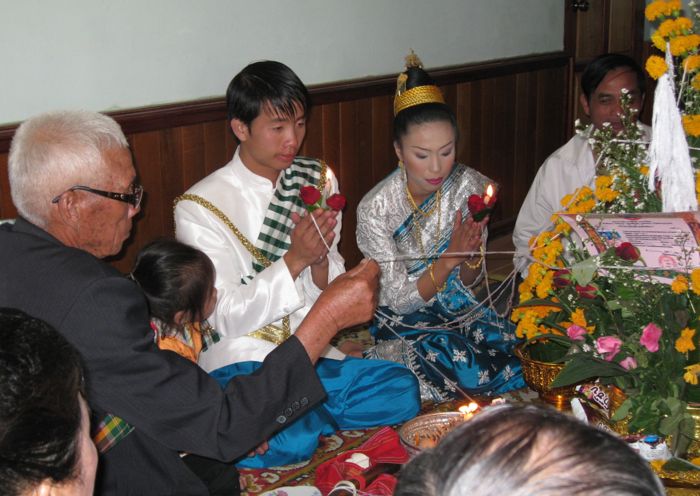 The actual wedding ceremony is led by a Mor Phone, an elder who has been a Buddhist monk and chants both Buddhist prayers and special wishes for the marriage.
 After the party in the afternoon, there's also a reception in the evening. Everyone has a good time.
Friday, November 30, 2007

Drove the long trip down from Xieng Khouang back to Vientiane. We had some meetings in the morning, so didn't leave till 11 am, and then arrived in Vientiane around 8 pm. The final stretch of highway is poorly lit and difficult to navigate after sunset. The stars were out and quite beautiful, kept me from playing backseat driver.
I'm glad that this vehicle was not on the road. We were just rounding a bend when we passed this elephant. We don't see them as much as we used to, and they're not so common in the north. I suspect that this is a working elephant, being used in logging. Anyway, it provided an interesting break from the usual animals we have to dodge on the road, such as chickens, cows, water buffaloes and goats.
Friday, November 16, 2007
People think of Laos as being exotic. Well, it is exotic but I've lived here for so long that most of the exotic things are pretty normal. Not willing to get into discussion of by whose standard one should judge normal, I'll just post this picture of a normal cat and her kittens. Well, she's my cat and her name is Alpha. She had her kittens on the 14th and they are very cute.

I try not to post too many cat and kitten pictures, but I can't help it. My cat does produce some very nice off-springs.
Monday, November 12, 2007

With all the problems in Burma, I was amazed to find this book of matches that made me remember more peaceful days. I stayed at the Strand Hotel in Rangoon in 1987. Don't know how I managed to hold on to the matches for so long.
it was a pretty interesting trip. I had been working at a refugee camp in Thailand for over a year at that point. All the expatriate staff lived together in traditional houses in a town near the camp; there wasn't much to do there so we all became good friends, going to Bangkok together after work on Saturdays and taking vacations together. So I went to Burma with some of these friends.
At that time, there wasn't any hint of the upheaval to come - everyone was uniformly depressed and struggling to get by. I knew a lot of Burmese who were working as medical staff in the camps and offered to bring a letter or say hello to their relatives. One woman gave me a bundle; I didn't even think to question what was inside. So I was rather surprised and weirded out to be questioned by customs as we entered the country. I opened the paper bag and all the gift wrappings on the presents - which turned out being wrinkled apples and scraps of brightly colored fabric. The guard lectured me on bringing this junk into the country. I felt ashamed that my friend was sending what seemed to be valuable to her - the love behind the sad little gifts.
Meeting her relatives was awkward. They came to the hotel - the Strand - and left as quickly as they could, maybe before anyone could report them. The Strand itself was ten dollars/ night with the three of use staying in one room. The plumbing was shot and the paint peeling from the walls. The finest hotel in the city at the time.
You were allowed a one week visa, which was barely enough time to spend a day in Rangoon, travel to Mandalay, Pagan and back. But the images just stayed with me. The people were radiant for all their troubles and very happy to see tourists, just because of the connection with the outside world.
Some of the highlights of the trip included the train ride from Rangoon to Mandalay - one of my friends and I had gotten off the train, and when we got on, we realized we were in the wrong car. There was no way to move between cars - so we had to wait until the next station. Meanwhile our other friend tried to sit still, wondering if he'd ever see us again.
Climbing up Mandalay Hill, the whole hill covered with staircases and temples until we got to the top after making offerings at many shrines along the way. We flew from Mandalay to Pagan. Pagan, an ancient city, is one of the most beautiful and haunting places in the world. We hired a horse cart to take us around the temples.
Anyway, those are just a few thoughts that came back when I found this matchbox in my desk drawer. May the Burmese find peace and happiness - and democracy very soon.
Friday, November 09, 2007
Our donor trip has started off well. Quite a bit of champaign and wine, because the restaurant was slow in preparing the meal. I think we all bonded well.
We'll all meet each other again in the morning - 5 am to be exact - when we go to the airport and get on the early morning flight and then drive two hours to the project site.
Off to bed now.
We'll all meet each other again in the morning - 5 am to be exact - when we go to the airport and get on the early morning flight and then drive two hours to the project site.
Off to bed now.
Wednesday, November 07, 2007
What happens after boat racing

The boat races have ended. The boats in our village were dragged up the river bank and parked in the shelter next to the temple. This is one boat, about 50 feet long, carved out of a single log. The workmanship is quite amazing.
Tonight we were eating dinner at a restaurant on the river. The sun had already set and there was no light at all on the water, except for the distance lights across the river reflected on the water. I could hear the voices of the rowers on a long boat, shouting in unison to coordinate their strokes. I couldn't imagine what they were doing on the water, after dark, at the end of the boat racing season. When they floated down the river, I thought that maybe their were taking their boat home. But they returned, paddling upriver.
Maybe it was a ghost boat. And only my friends and I had seen it. Maybe they will come for me tonight, since I know their secret.
Time to go to sleep, if I can dare to sleep.
Tuesday, November 06, 2007
Monday, November 05, 2007
Traffic...just saying...
Most of my friends have one of two impressions of Laos. They think of stereotyped images of developing countries - impoverished, vultures flying overhead ready to swoop down on people if they don't keep moving. Or they'll chirp," Oh, Asia. How fun!"
Needless to say, the reality is between the two extremes. And so my illustration, and rant for the day, is Traffic. Not human or drug traffic but motor vehicle traffic.
I do have a car. And most days I drive the four miles to work. It can be a drag to arrive at work, sweaty and dusty and have to run off for a meeting with government officials. And since I'm in the medical field, I'm terrified of motorcycles.
When I first started working in Laos, most people rode 1-speed bicycles. There were a few motorcycles and the people on bicycles stared at the rare car when it went by. Now, it's the other way around, cars are common in Vientiane and the drivers don't stare, much less look, at anyone. The drive to work this morning - motorcycles passing on the right just as I was making a right turn, having to stop suddenly because a recycling technician had pushed his cart into the traffic lane, and having vehicles driving towards me on the one lane road - totally depleted my stock of swear words for the whole day.
On the other hand, I should remind myself that driving in Vientiane traffic can substitute for aerobic exercise when I haven't gotten up early enough to go running. And I also have to remind myself that traffic has started to go faster as the roads have gotten paved; I'm not about to advocate to returning to the roads with the car-sized ruts in them.
I guess I'm crabby because I prefer being out in the provinces. But it is true that motor vehicle accidents are rising all over the world - the WHO figures that trauma, of all types, will be the number two cause of mortality and morbidity by the year 2020. Is that an improvement over diarrhea and acute respiratory infections?
Well, time to rest up before the next excursion into mayhem.
Needless to say, the reality is between the two extremes. And so my illustration, and rant for the day, is Traffic. Not human or drug traffic but motor vehicle traffic.
I do have a car. And most days I drive the four miles to work. It can be a drag to arrive at work, sweaty and dusty and have to run off for a meeting with government officials. And since I'm in the medical field, I'm terrified of motorcycles.
When I first started working in Laos, most people rode 1-speed bicycles. There were a few motorcycles and the people on bicycles stared at the rare car when it went by. Now, it's the other way around, cars are common in Vientiane and the drivers don't stare, much less look, at anyone. The drive to work this morning - motorcycles passing on the right just as I was making a right turn, having to stop suddenly because a recycling technician had pushed his cart into the traffic lane, and having vehicles driving towards me on the one lane road - totally depleted my stock of swear words for the whole day.
On the other hand, I should remind myself that driving in Vientiane traffic can substitute for aerobic exercise when I haven't gotten up early enough to go running. And I also have to remind myself that traffic has started to go faster as the roads have gotten paved; I'm not about to advocate to returning to the roads with the car-sized ruts in them.
I guess I'm crabby because I prefer being out in the provinces. But it is true that motor vehicle accidents are rising all over the world - the WHO figures that trauma, of all types, will be the number two cause of mortality and morbidity by the year 2020. Is that an improvement over diarrhea and acute respiratory infections?
Well, time to rest up before the next excursion into mayhem.
Sunday, November 04, 2007
Si Khai Boat racing update

The festivities around the boat races continued at a frantic pace all day. After I returned from the office, one of my neighbors came running over to my house with a bowl of Khao Phung, a spicy curry made with coconut milk over fermented rice noodles with fresh vegetables. After being refreshed with lunch I walked along the levee, going to the river side when I noticed that people were looking out over the river and jumping up and down. Last year, I had a much better idea of the villages and the rowers in the festival but since I've been upcountry so much, I've been out of touch.
One thing I was amazed to see was that there were corporate sponsorships of several boats. Last year, one of the villages around my temple had made their own boat. Although it was an amazing process of hollowing out and carving the log and making struts to support it, the boat was slightly twisted, so it took on water easily. It didn't get too far in the races last year because some of the rowers had to bail. This year I saw the bowl sporting a "Nissan" plaque instead of the name of a village. I was scandalized. Then I noticed that the EU had sponsored a boat - they all had on the blue tees with a pattern of the circle of gold stars for member countries. They also had their own tent and band by the river side.
 The problem with corporate sponsorship is that they tend to draw from a wider range of people within their offices rather than people in a village. And the competition becomes less for for and more for profit and maybe exposure for the organization.
I was about halfway between the start and the finish lines when they had the last race - between the EU and a local village boat. And the village boat won!
Saturday, November 03, 2007
It's Saturday morning and the day started quietly - the neighbors calling each other as they went to the Wat, summoned by the booming of the large drum. The monks walked past my house, silently walking in bare feet and carrying their metal begging bowls filled with sticky rice and different kinds of curries.
It's now about 7:30 and the sounds are different - loud music and the whirr of air compressors inflating the bouncy castles. The Si Khai boat races are happening today and by 9 am, the temple yard of Wat Meuang Wa will be filled with people. And at noon, the traditional long boats will be racing.
The tradition of boat racing goes back a long time. During the Buddhist Lent, people are supposed to follow the "Ha Sihn" or the five basic Buddhist precepts more strictly - no alcohol or other drugs, lying, naughty activities, stealing or killing (some people are vegetarian for the three months) - and they should stay close to home and work in the rice fields. While modern life is a little different, the world is quieter during the rainy season; fewer cars on the road and there are only wedding parties if it is essential. At the end of the season, there are many Boun, merit making ceremonies at the temples, which include the above reference temple fair.
And the boat racing. The legend is that the Naga, snake spirits who live in watery areas, also lie low during the rainy season but at the full moon in the tenth month, they are ready to have a little fun. The Naga King had protected the Lord Buddha from a thunderstorm when he was in meditation under the Bodhi Tree and since then, all Naga follow Buddhism. The boat races and special offerings (floating little boats made of banana leaves, filled with flowers, candles and incense) are dedicated to the Naga spirits. And the boat races have a special function - people in villages teams practice during the last month of the rainy season and then compete up and down the river up to the big boat race in Vientiane on the day after the October full moon (that was last Saturday). Not only do villages on the Lao side go back and forth and socialize but teams from across the Mekong river, also compete. In the late 80's, while I was working in a refugee camp in Thailand, I traveled to Nong Khai for the boat races - Laos was just starting to open up after its years of self-imposed isolation so the big thing was seeing the Lao teams competing on the Thai side of the river.
For some reason, the Si Khai races are after the big race in Vientiane. The main race has gotten much more corporate - the teams are not villages but mostly companies. In the past few years, I've skipped the main races but I do like my neighborhood races - they're entirely from villages and the event is smaller and much more fun. Last year, I sat at the finish line with some Lao friends, one of whom was the main sponsor of his village team.
This year, I'm not sure. In a moment, I'll be heading to my office and hopefully will get back for the afternoon activities.
It's now about 7:30 and the sounds are different - loud music and the whirr of air compressors inflating the bouncy castles. The Si Khai boat races are happening today and by 9 am, the temple yard of Wat Meuang Wa will be filled with people. And at noon, the traditional long boats will be racing.
The tradition of boat racing goes back a long time. During the Buddhist Lent, people are supposed to follow the "Ha Sihn" or the five basic Buddhist precepts more strictly - no alcohol or other drugs, lying, naughty activities, stealing or killing (some people are vegetarian for the three months) - and they should stay close to home and work in the rice fields. While modern life is a little different, the world is quieter during the rainy season; fewer cars on the road and there are only wedding parties if it is essential. At the end of the season, there are many Boun, merit making ceremonies at the temples, which include the above reference temple fair.
And the boat racing. The legend is that the Naga, snake spirits who live in watery areas, also lie low during the rainy season but at the full moon in the tenth month, they are ready to have a little fun. The Naga King had protected the Lord Buddha from a thunderstorm when he was in meditation under the Bodhi Tree and since then, all Naga follow Buddhism. The boat races and special offerings (floating little boats made of banana leaves, filled with flowers, candles and incense) are dedicated to the Naga spirits. And the boat races have a special function - people in villages teams practice during the last month of the rainy season and then compete up and down the river up to the big boat race in Vientiane on the day after the October full moon (that was last Saturday). Not only do villages on the Lao side go back and forth and socialize but teams from across the Mekong river, also compete. In the late 80's, while I was working in a refugee camp in Thailand, I traveled to Nong Khai for the boat races - Laos was just starting to open up after its years of self-imposed isolation so the big thing was seeing the Lao teams competing on the Thai side of the river.
For some reason, the Si Khai races are after the big race in Vientiane. The main race has gotten much more corporate - the teams are not villages but mostly companies. In the past few years, I've skipped the main races but I do like my neighborhood races - they're entirely from villages and the event is smaller and much more fun. Last year, I sat at the finish line with some Lao friends, one of whom was the main sponsor of his village team.
This year, I'm not sure. In a moment, I'll be heading to my office and hopefully will get back for the afternoon activities.
Friday, November 02, 2007
Just a bit about daily life

Friends are always asking about what I do every day. It's difficult to give an example of just one day because I work in three areas of Laos. Our main project, doing medical upgrading and assisting people injured by unexploded ordnance, is focused in the south in the provinces crossed by the old Ho Chi Minh trails. I spend at least half the month there and end up taking the overnight bus to Vientiane, the capital of the country, for meetings and report writing. And then we have work in the north - strengthening the systems of providing UXO survivor assistance which includes immediate medical treatment as well as providing vocational training and economic funds for people who have been injured by unexploded ordnance.
There's a lot of travel involved. So on Wednesday, we returned to Vientiane by truck, an eight hour drive along twisty mountain roads. This is what the road looks like just north of Vang Vieng, one of the most beautiful places in the country:
 On a travel day like this, I wake up about 5 am, usually with the intent of going for a run; however, I most often end up packing the things I had forgotten the night before. We planned to leave at 7 am - however during the evening people kept calling, asking to send things with us or trying to get a lift. So starting at 7, my field assistant went around collecting people and things. Then we had too many things, so I told them to unload some bags so we could put the rain tarp on top of everything. So about 8:30, we set off.
Our first stop was at a school, to meet the father of one of the UXO survivors we helped. The child had been taking medication so I wanted to check that he was still doing all right. Problem solving done, we continued on, stopping at another village to check in with another UXO survivor. As usual, we had lunch in Kasi followed by four more hours of driving to Vientiane - where it started to rain. Got home at about 7 pm. I wanted to conk out right away - but NaNo was going to start at midnight. I stayed up and starting writing at midnight. And that was my day!
Thursday, November 01, 2007

I'm planning for a lot of writing for November. First, I've vowed to post to this blog daily, cause there are things I like about blogspot and other blogs on blogspot so why not? And I'll still be participating in NaNoWriMo as well. I live in a place where the days get cooler in November and its dusty and dry but the real thing that makes November feel like November for me is NaNoWriMo.
It's going to be a crazy month. We have a big guest coming next week, I'll have to go to the project sites both in the south and in the north, and try to write on top of all that? We'll see how it goes. Always up for a challenge.
Thursday, October 18, 2007
In Vientiane

Since my last post, I've been down to the south and back up here to Vientiane. I took the overnight bus in both directions. Every time I travel, there seem to be new bus options. When I first came to Laos, the buses were old, uncomfortable and crowded and while there still are these old buses on the road, there are also newer options. Now, there are sleeper buses - double bunk beds, each bunk narrower than a single bed and two people can sleep on it. Fortunately, in both directions the bus was not crowded so I had a bed to myself.
Sunday, October 07, 2007
back home, in time for more rain
kThe return trip always seems shorter. At least this time it was more comfortable - I got an economy plus seat, with no one next to me so I could put my feet up. Watched two movies on the flight, one of them excellent (Away from Her, with Julie Christie, based on a story by Alice Munro). It seemed like no time we were in Tokyo, where we had too much time, like three hours, to wait for the connecting flight.
And readjusting to time zones always seems easier in this direction. Well, I have to stay awake for work so I force myself through jetlag.
When I left Seattle, the weather was gray and rainy. Since I've been home, we've gotten the leftovers from Typhoon Lekima. At least the rain is warm, though a bit of it. This was the view from my bedroom window yesterday afternoon:
And readjusting to time zones always seems easier in this direction. Well, I have to stay awake for work so I force myself through jetlag.
When I left Seattle, the weather was gray and rainy. Since I've been home, we've gotten the leftovers from Typhoon Lekima. At least the rain is warm, though a bit of it. This was the view from my bedroom window yesterday afternoon:

Saturday, September 15, 2007
In the US for home leave

I've been in the US for a week now. The first few days I walked around in a total daze, but the jet lag is better and I'm feeling more accustomed to being here. I just finished a five day medical conference to get some CME. Very interesting and worthwhile but now what? Will stay the weekend in Seattle then head to California to visit friends in Merced and wander about San Francisco for a day. Visit museums and breathe in the fog.
The picture is of flowers in the Pike Place market. Most of the flower vendors are Hmong, who resettled around Carnation Valley. Last year, their farms got wiped out by floods and bad weather so I was happy to see them selling flowers again. Hmong are the most resilient people.
Thursday, August 30, 2007
Monsoon season

This is a beautiful time of the year. I can't believe that after eleven years in Lao that I can still get so excited by the beauty of rice fields - but every day, it's like waking up fresh to the world.
Unfortunately, we feel climate change here. When I first moved here in 1996, the month of August was agony - rain all the time towards the end of the monsoon. My road was ankle deep in mud and I couldn't go anywhere without getting soaking wet. And nothing ever dried.
For the past few years, the rain might start really early before stopping in northern Lao. These past two weeks, it's been hot during the day with a thunderstorm every other day which threatens to tear up the rice plants from the field.
Paddy rice was cultivated in water because it keeps the pests down and has higher yield than rice planted on the hillsides in the mountains. With the water low, the worms and other bugs can get at the roots of the plants, decreasing the yield. If it floods, the rice plants can't survive if they are submerged for more than a day.
The life of a rice farmer is difficult at best, even without the new extremes in weather.
Monday, August 20, 2007
Rainy season

This past week has been the usual frenzy, drove from Salavan to Vientiane on Saturday. Yesterday, I ran around trying to do some laundry, house cleaning and exercise. Did spend an hour at the health club though did not go swimming - too many kids in the pool. Today, I spent a wild morning in the office - although I had a plan about what I would do in the few hours, my boss called a meeting. Final rush to get to the airport where I fly up to Xieng Khouang with a training team who will be doing a workshop on livelihoods development over the next few days.
Once I got home, I walked in circles. And then laid down for a nap most of the late afternoon. Good to be back up north.
It's been raining a lot in Salavan - everything is every shade of green. This picture is from the front porch of my house where I spent the few hours after work on Thursday, reading and gazing at the raindrops.
Sunday, August 12, 2007
No pitchurs today
It seemed that every time I stepped out of the house, the rain would zero in on me. I tried to go for a run in the morning - that lasted about five minutes before I ran back home. It continued thunderstorming for a few hours. Later in the afternoon, I brought my umbrella (which usually guarantees that it will not rain) and checked in all visible directions for rain before leaving the house. The sheet of rain sailed in from the direction hidden behind my neighbor's trees.
I continued walking in the rain, pretty much getting soaked. After walking 3 kms. I went back to the house as the sun was peeping out. At the end of the runway, I saw some familiar forms so stopped to talk with a German couple who are running a farm in Salavan. Meanwhile, they let their kids loose on the tarmac - they ran into every puddle and churned up mud with their bikes so that in the ten minutes I talked with the parents, the kids managed to cover themselves with mud. I felt clean in comparison.
Because it was raining so much, I didn't take any pictures. And I think I've taken even monsoon pictures for the year anyway. Or at least that's what I'm thinking today.
Anyway, it's been kind of a diddly weekend. We went into Pakse yesterday and interviewed some job applicants at a restaurant. Had lunch while waiting for the last person to show up (he left Attapeu at 6 am and finally arrived at 3 pm). I finished Harry Potter and the Whatever; pretty enjoyable. I appreciated some of the craft of writing - writing of action scenes, some nifty plot twists and filling in background for non-Potter fans (like myself) with a sentence or two rather than engaging in infodumps.
I also read A Thousand Splendid Suns by Khaled HOsseini. I liked this book better than The Kite Runner. Well, I liked the first 2/3 of the The Kite Runner for the same reason I liked A Thousand Splendid Suns - both books make Afghani history and culture come alive against the background of the political events. What I didn't like about The Kite Runner was the the bizarre events surrounding the return to Afghanistan at the end of the book - it was too unreal. But A Thousand Splendid Suns sticks with the real situations and how the constant war affected people, bringing out the worst as well as the best. The friendship between Laila and Mariam is well written and heartbreaking. The only weak points of the book is that sometimes the insertion of what was happening was a little rough and kinda didactic.
I continued walking in the rain, pretty much getting soaked. After walking 3 kms. I went back to the house as the sun was peeping out. At the end of the runway, I saw some familiar forms so stopped to talk with a German couple who are running a farm in Salavan. Meanwhile, they let their kids loose on the tarmac - they ran into every puddle and churned up mud with their bikes so that in the ten minutes I talked with the parents, the kids managed to cover themselves with mud. I felt clean in comparison.
Because it was raining so much, I didn't take any pictures. And I think I've taken even monsoon pictures for the year anyway. Or at least that's what I'm thinking today.
Anyway, it's been kind of a diddly weekend. We went into Pakse yesterday and interviewed some job applicants at a restaurant. Had lunch while waiting for the last person to show up (he left Attapeu at 6 am and finally arrived at 3 pm). I finished Harry Potter and the Whatever; pretty enjoyable. I appreciated some of the craft of writing - writing of action scenes, some nifty plot twists and filling in background for non-Potter fans (like myself) with a sentence or two rather than engaging in infodumps.
I also read A Thousand Splendid Suns by Khaled HOsseini. I liked this book better than The Kite Runner. Well, I liked the first 2/3 of the The Kite Runner for the same reason I liked A Thousand Splendid Suns - both books make Afghani history and culture come alive against the background of the political events. What I didn't like about The Kite Runner was the the bizarre events surrounding the return to Afghanistan at the end of the book - it was too unreal. But A Thousand Splendid Suns sticks with the real situations and how the constant war affected people, bringing out the worst as well as the best. The friendship between Laila and Mariam is well written and heartbreaking. The only weak points of the book is that sometimes the insertion of what was happening was a little rough and kinda didactic.
Tuesday, August 07, 2007
Moving bamboo

The first time I stayed in Chang Khan, Thailand, I remember the darkness on the Lao side of the river. At night, there was only the tree line against the field of stars. I asked the friend I was staying with why there were not even the lights of cars in the town. "Very few people in Laos have cars and there aren't any roads. Most of the towns on the river use the river."
Things have changed - there are still the slow boats that go up and down the river, sunk low in the water because of the weight of whatever they're transporting. And bamboo is cut up river and floated down to Vientiane, where groups of people working together haul them up on the levee and made furniture, baskets, matting and fencing from the bamboo.
The daughter of a friend of mine missed one question on her final high school exam. The question was "What is the most important kind of wood and why?" She wrote "bamboo" and listed all the reasons why. The correct answer was "teak" because it's expensive and is exported (however, the profits from teak go to only a few). But bamboo - you can't go through a day without touching something made of bamboo, whether it's a floor mat, a sticky rice basket, the house you're living in, a fence made of bamboo where you're hanging your clothes to dry. It's an egalitarian kind of wood.
Bamboo on the shore. In both pictures, the city on the opposite bank is Sri Chiengmai in Nongkhai Province.

Monday, August 06, 2007
Weekends

Weekends never last long enough. I did have a good deal of quality time with house cleaning, organizing my house, washing and ironing. Yes, even in Paradise, we have to do all that. My landlady "helps" me when I'm out in the field. She feeds the cats, washes the dishes and gets into the main part of the house, insisting that she is cleaning. I can never find things after she has helped me. So this weekend, I found the return plane ticket that had gone missing from last year (now I can't even get a refund), half-read books that she had placed in shoe boxes and expired medicines.
Sigh. There's not much I can do other than contemplate beauty. So a few beautiful pictures of my bicycle trips on the weekend are in order.
It's the monsoon season and everyone's planting rice. It seems that people are planting later this year - I think because the nonirrigated fields are not getting enough rain. I've lived in Asia for fifteen years and have seen the cycle of rice that many times. I never get tired of the miracle of the brown hard laterite earth turning green with rice plants.

Friday, August 03, 2007
Happy Friday
I've been running around toooo much with most of my weekends fractured by long train or bus trips. But this weekend, I'm not going any where except to lie on the couch and finish reading the Harry Potter book, followed by as many of the other books in stacks that I can get my hands on and my eyes around.
Today was spent in office work. I try to avoid that as much as possible but it has to be done sometimes. In the afternoon, I visited the nurse trainer who organizing a nursing management course to work out the syllabus and the schedule with her. She's one of the most organized people I know and we've put together programs together for the past ten years so it was a pretty enjoyable visit. I left the hospital feeling satisfied that these nurses will learn things that they'll be able to use.
I wanted to take a picture of the Setthirath Hospital but my secretary who accompanied me, started having some contractions (she's 8.5 months along and having Braxton-Hicks contractions) so we just returned to the office. Later, I took this picture instead of exercising - I just ate dinner and returned home.

A funny, but great, craze that's been sweeping Lao and Thailand has been aerobics. When I first arrived in Lao, I'd go running in the mornings and most folks thought I was daft. "If you want exercise, feed some pigs." Of course, I was not about to buy some pigs but that didn't stop people rolling their eyes. But as the economy has gotten better, most professional people have transferred the farm chores and rice planting to their country relatives. And they have started to get tubby as a result. So a lot of hospitals and social groups have gotten into doing aerobics several times a week.
Today was spent in office work. I try to avoid that as much as possible but it has to be done sometimes. In the afternoon, I visited the nurse trainer who organizing a nursing management course to work out the syllabus and the schedule with her. She's one of the most organized people I know and we've put together programs together for the past ten years so it was a pretty enjoyable visit. I left the hospital feeling satisfied that these nurses will learn things that they'll be able to use.
I wanted to take a picture of the Setthirath Hospital but my secretary who accompanied me, started having some contractions (she's 8.5 months along and having Braxton-Hicks contractions) so we just returned to the office. Later, I took this picture instead of exercising - I just ate dinner and returned home.

A funny, but great, craze that's been sweeping Lao and Thailand has been aerobics. When I first arrived in Lao, I'd go running in the mornings and most folks thought I was daft. "If you want exercise, feed some pigs." Of course, I was not about to buy some pigs but that didn't stop people rolling their eyes. But as the economy has gotten better, most professional people have transferred the farm chores and rice planting to their country relatives. And they have started to get tubby as a result. So a lot of hospitals and social groups have gotten into doing aerobics several times a week.
Thursday, August 02, 2007
Around Phonsavanh
 I haven't posted any pictures for a while, just haven't had the time when I've been near a fast internet connection. I took this picture when I went for a bicycle ride when I was in Xieng Khouang. At the start of the rainy season, it rains heavily for a short time then the sun comes out and the air is so clear. I like the way the bamboo springs out - the branches look like the tails of frisky young animals.
This picture only about an hour away from my house. The distant hills are about 20 kms away, to the west of Phonsavanh. There's a long of "progress" in Xieng Khouang but there still are quiet places. Ban Vieng, the last village I rode through didn't have electricity and although they had to carry their water from wells, there was water to carry. I stopped and talked to folks and finally had to beg off offers of meals and drinks.
One sobering thought is that later, as I was going though the UXO statistics over the past few years, I noticed that there had been several UXO incidents in Ban Vieng. Even though the war ended over thirty years ago, people's lives are still at risk.
Shadows and Light online
There's an interesting writing contest at the Clarity of Night website. I originally saw the notice at my favorite writing group, Musemuggers and thought I'd give it a go. My submission is here
Wednesday, August 01, 2007
What happened after the previous entry
I was so eloquent about the start of the Buddhist Lent in the previous entry that I was really shaken by what happened later on in the day.
As I was driving back from the health club, two teenagers on a motorbike rear-ended me. Fortunately, I was driving really slowly. One of these things I'll never forget is hearing the thud of the motorbike hitting the back of the car and looking up in the rear view mirror and seeing the driving of the motorbike hitting the top of the trunk.
Surprisingly, of all the possibilities present, the realities were not so bad. The kids only had cut lips, the police came quickly, followed by the kids' mother. And the insurance guy came to the site and declared the boys at fault for following too closely, a common Lao practice.
I was really shook up though. Since I've lived in Asia, I've seen so many horrible accidents and have lost friends to the flow of traffic. It really could have been much worse.
When I first visited Lao in 1994, Vientiane was a city of creaky one-speed bicycles. There were a few motorcycles then, but they were old and covered with rust and not capable of much speed. As years went on, the roads filled with motorcycles bumping over the rutted dirt roads. The city started to pave the roads which allowed bigger cars to start dominating the streets. The Volgas and Moscowitches gave way to newer used cars. Now, Landcruisers and sleeker modern cars create traffic jams - and when there's no traffic, they race along like maniacs.
The kids' motorcycle was of the new generation of bikes - cheap bikes from China. It disintegrated on the road. I was surprised that my car, a ten year old Korean knock-off, survived with its plastic bumpers.
Anyway, I hope that the rainy season retreat will really mean more mindful driving and fewer accidents.
As I was driving back from the health club, two teenagers on a motorbike rear-ended me. Fortunately, I was driving really slowly. One of these things I'll never forget is hearing the thud of the motorbike hitting the back of the car and looking up in the rear view mirror and seeing the driving of the motorbike hitting the top of the trunk.
Surprisingly, of all the possibilities present, the realities were not so bad. The kids only had cut lips, the police came quickly, followed by the kids' mother. And the insurance guy came to the site and declared the boys at fault for following too closely, a common Lao practice.
I was really shook up though. Since I've lived in Asia, I've seen so many horrible accidents and have lost friends to the flow of traffic. It really could have been much worse.
When I first visited Lao in 1994, Vientiane was a city of creaky one-speed bicycles. There were a few motorcycles then, but they were old and covered with rust and not capable of much speed. As years went on, the roads filled with motorcycles bumping over the rutted dirt roads. The city started to pave the roads which allowed bigger cars to start dominating the streets. The Volgas and Moscowitches gave way to newer used cars. Now, Landcruisers and sleeker modern cars create traffic jams - and when there's no traffic, they race along like maniacs.
The kids' motorcycle was of the new generation of bikes - cheap bikes from China. It disintegrated on the road. I was surprised that my car, a ten year old Korean knock-off, survived with its plastic bumpers.
Anyway, I hope that the rainy season retreat will really mean more mindful driving and fewer accidents.
Saturday, July 28, 2007
Buddhist Lent
Tomorrow starts the season of the Buddhist Lent, called Khao Phansaa. During this season, everyone is supposed to be on their best behavior - no alcohol or drugs, no fooling around, no weddings or other loud parties. We had a happy hour at the office yesterday, so we started discussing what we were all going to abstain from over the next three months. For me, no alcohol and I'm going to go back on a high glycemic index diet, exercise daily and lose weight. I've done that before and both my glucose and cholesterol were in much better control. The only problem is in keeping it up - recently, between both work and travel, it's just been too crazy.
The rainy season is mainly a time for introspection. It follows the period of time when the rice has been planted, but people should not be traveling because they should be preparing for the coming year. Monks are supposed to stay at their home monasteries so they do not walk in the fields and kill the tiny animals by stepping on them.
Unfortunately, with modern times and development, the principles of the rainy season are not followed as carefully as before. People have parties and there are even weddings during this time. When I first came to Laos, everything grew quiet during the rainy season; there were few motor vehicle accidents because people stayed at home and did not drink. Now things continue much as before, with some of the elders following the principles of the Buddhist Lent.
The rainy season is mainly a time for introspection. It follows the period of time when the rice has been planted, but people should not be traveling because they should be preparing for the coming year. Monks are supposed to stay at their home monasteries so they do not walk in the fields and kill the tiny animals by stepping on them.
Unfortunately, with modern times and development, the principles of the rainy season are not followed as carefully as before. People have parties and there are even weddings during this time. When I first came to Laos, everything grew quiet during the rainy season; there were few motor vehicle accidents because people stayed at home and did not drink. Now things continue much as before, with some of the elders following the principles of the Buddhist Lent.
Wednesday, July 11, 2007
Well, life is...
...still carrying me away. Don't have nearly enough time to do the things I have to do. And then there's the things I should do. And a small portion of the day devoted to what I want to do. Job satisfaction? Don't ask.
However, today we had an incredible preparation training for a workshop we're doing next week. The consultant is a good friend and we work well together. I could see the smoke coming out of people's ears, from having to think so much. But I know that it's good for them!
However, today we had an incredible preparation training for a workshop we're doing next week. The consultant is a good friend and we work well together. I could see the smoke coming out of people's ears, from having to think so much. But I know that it's good for them!
Wednesday, April 25, 2007
Change of seasons
It can get unbearably hot in Asia - but seems worse than usual this year. Thunderstorms raced across the country during the Lao New Year. A strong windstorm in Khammouane blew down over 100 houses. But after those atmospheric theatrics, the weather calmed.
And grew hotter. The headline story of the Vientiane Times reported on the heat wave, how afternoon school sessions may have to be cancelled for a week because the students were using their school books to fan themselves and they could not attend to lessons anyway.
This evening, the sky blackened and I rushed home. I often like to go to the gym and dawdle downtown afterwards to eat dinner, but tonight I decided I didn't want to drive in the mess. They've been repairing the streets so the danger of potholes on unlit roads is made worse by motorcycle drivers weaving between cars in traffic with their lights off, old men pushing wooden carts filled with scrap metal and plastic bottles, and people driving in shiny SUVS trying to push you off the road.
The storm arrived with high winds and lightening. But it lasted only a few minutes. The cool air lingered. I'll sleep well tonight for a change
And grew hotter. The headline story of the Vientiane Times reported on the heat wave, how afternoon school sessions may have to be cancelled for a week because the students were using their school books to fan themselves and they could not attend to lessons anyway.
This evening, the sky blackened and I rushed home. I often like to go to the gym and dawdle downtown afterwards to eat dinner, but tonight I decided I didn't want to drive in the mess. They've been repairing the streets so the danger of potholes on unlit roads is made worse by motorcycle drivers weaving between cars in traffic with their lights off, old men pushing wooden carts filled with scrap metal and plastic bottles, and people driving in shiny SUVS trying to push you off the road.
The storm arrived with high winds and lightening. But it lasted only a few minutes. The cool air lingered. I'll sleep well tonight for a change
Friday, September 15, 2006
A walk around town
Salavan is small - even smaller than Phonsavanh. And it feels small - like today, I went for a run in the late afternoon. In some places, it's very ugly - everything is new because the entire city had been destroyed, totally leveled during the war. Other places, the central part of the city and the areas by the Xedone River are nicer. Teak houses and meeting halls that were built right after the war.
I started off from behind our staff house/ office, off the road into the bushes. A few moments later, I was on the strip of the old airport - small planes used to land here until Lao Aviation cut off the road. Now, it's a place to fly kites and to play badminton.
I ran to the end and past the house that I plan to rent. A few steps later, I ran into (almost literally) into Dr. K, who owns the house. We talked for a few moments about when they'll have the house fixed up and I can move in. I'm very happy about that, because the nightclub next to the office is not endearing itself to me.
A few more steps and my cell phone rang, so I talked, in Lao, with my friend while all the neighborhood kids gathered around to look at a foreigner talking on a cell phone.
I continued onward, deciding to stop in the market to get a phone card. While there, I meet one of the people from the Dept of Education - haven't seen him for a year at least, but he said that he's seen me running. He told me that our education staff were in town, which I hadn't known.
I left the market before someone else recognized me and stopped at a pharmacy to get some aspirin. The woman at the pharmacy asked me if I lived in Salavan and I started talking about our project; turned out she was Dr. K's wife.
Onward - I passed a house which turned out being R's new house. He's one of education staff and he and the drivers were sitting outside so I had to sit with them for a moment. By now, it was starting to get dark so I left. The last mile of my run was in the dark, which is a little scarey because there are no street lamps and I wasn't sure if someone would run me over or whether I'd end up in a ditch.
The folks who went into Pakxe today returned with Indian food. Yummy - better than frogs or deep fried crickets any day!
I started off from behind our staff house/ office, off the road into the bushes. A few moments later, I was on the strip of the old airport - small planes used to land here until Lao Aviation cut off the road. Now, it's a place to fly kites and to play badminton.
I ran to the end and past the house that I plan to rent. A few steps later, I ran into (almost literally) into Dr. K, who owns the house. We talked for a few moments about when they'll have the house fixed up and I can move in. I'm very happy about that, because the nightclub next to the office is not endearing itself to me.
A few more steps and my cell phone rang, so I talked, in Lao, with my friend while all the neighborhood kids gathered around to look at a foreigner talking on a cell phone.
I continued onward, deciding to stop in the market to get a phone card. While there, I meet one of the people from the Dept of Education - haven't seen him for a year at least, but he said that he's seen me running. He told me that our education staff were in town, which I hadn't known.
I left the market before someone else recognized me and stopped at a pharmacy to get some aspirin. The woman at the pharmacy asked me if I lived in Salavan and I started talking about our project; turned out she was Dr. K's wife.
Onward - I passed a house which turned out being R's new house. He's one of education staff and he and the drivers were sitting outside so I had to sit with them for a moment. By now, it was starting to get dark so I left. The last mile of my run was in the dark, which is a little scarey because there are no street lamps and I wasn't sure if someone would run me over or whether I'd end up in a ditch.
The folks who went into Pakxe today returned with Indian food. Yummy - better than frogs or deep fried crickets any day!
Wednesday, September 13, 2006
Nightclubs in the Wilderness
Until I rent my own house here in Salavan, I'm staying with my staff in the combination staff house/ office. So I'm living in the same play where I work, with the people I work with. Don't have to commute far - it's kinda like telecommuting without the tele. Except for television - the guys love to watch the Thai soap operas at night, which give me a headache. But after a hard day at work which involves organizing training, editing training handbooks, and cutting through red tape, they're entitled to watching stories about the fast life in Bangkok.
Our house is just a little out of town - right in a short strip of nightclubs. The one next door is a shack with woven bamboo walls - which do nothing to cut down the constant pop music, mostly Thai. While they do play some songs that I like, from Carabao and Caravan (Thai alternative rock groups), I do prefer to hear the songs only once or twice... and my real preference is to be able to chose my own music.
Fortunately, they stop around 10 pm by which time I'm usually asleep with ear plugs in place. A few weekends ago, they started up the music and really cranked it up at 6 am. The only music that starts that early and plays that loud is for funerals; my staff though that was pretty funny and told the owner of the nightclub. Since then, they decided they would not start up so loud so early.
When I mention the music, my staff go "What music?" Since they all come from large families, I guess that noise is reassuring rather than a problem.
Our house is just a little out of town - right in a short strip of nightclubs. The one next door is a shack with woven bamboo walls - which do nothing to cut down the constant pop music, mostly Thai. While they do play some songs that I like, from Carabao and Caravan (Thai alternative rock groups), I do prefer to hear the songs only once or twice... and my real preference is to be able to chose my own music.
Fortunately, they stop around 10 pm by which time I'm usually asleep with ear plugs in place. A few weekends ago, they started up the music and really cranked it up at 6 am. The only music that starts that early and plays that loud is for funerals; my staff though that was pretty funny and told the owner of the nightclub. Since then, they decided they would not start up so loud so early.
When I mention the music, my staff go "What music?" Since they all come from large families, I guess that noise is reassuring rather than a problem.
Sunday, September 10, 2006
A Dark Night, Stormadly
"It was a dark and stormy night; the rain fell in torrents--except at occasional intervals, when it was checked by a violent gust of wind which swept up the streets (for it is in London that our scene lies), rattling along the housetops, and fiercely agitating the scanty flame of the lamps that struggled against the darkness."
--Edward George Bulwer-Lytton, Paul Clifford (1830)
A Dark Night, Stormadly
It was a dark and stormy night, filling the zombie's heart with glee, which even though, as everyone knows, zombies don't have hearts, or at least hearts which don't work in their assigned function of enriching the cells of our bodies, the space in the zombie's chest which once had housed a heart, had been an open pit of hunger and despair. Zombies are night owls and they don't beat around the bush when the sun does down.
The endless rain continued. And continued. As the moon rose, but the endless rain held back the romantic rays of the moonlight. The zombie continued with its mission, filled with glee but also thankful for the freezing temperature, the bite of the cold as sharp as a knife. It did not wish to putrefy any further until its mission was complete.
"Who's there?" Another dark form stood awkwardly by a sodden wall, The zombie floated by. In another life, it would have pounced on the human and would have done what zombies do to humans.
The zombie merged with the shadows. "If you don't come out, I'll shoot."
The zombie laughed and all the dogs in the neighborhood howled in response. "There's nothing you can do to me."
"That's good," the voice said. "I only have a banana for a gun."
Now the zombie shivered with fear, but laughed again to hide its despair. Bananas were good for humans, but were poisonous to zombies. He could just make out the form of the holder of the banana – smallish for a human, and bent-over in an odd posture.
The zombie said, "Just watch out. I'm a zombie, and you know what zombies do to humans."
"Oh, yeah," said the form. "Well, have I got news for you. I'm an aardvark, so how do you like those pickles." The aardvark threw the banana at the zombie, who fled, screamingly away but was not nimble enough on its feet. The banana hit the zombie's back, the potassium reacting with its flesh. For a moment, the dark of the underworld was lit with a flare that make all the shadow creatures run for cover.
The aardvark walked over to the smear decorating the sidewalk. "There goes a good banana," it mused. "I hope this zombie is really dead this time." He pulled out a cell phone, disguised as an apple and pressed a few wormholes. "I suppose we'll have to get an electroencephalogram just to be sure."
Another form trotted up to the aardvark. "Hey, Boss, waddhaya think the zombie was after?"
Fluffy the cat could be so dense, thought the aardvark. "I suspect the jewelry in the castle. That's what they're always after. Not very imaginative."
"You don't think this one's a decoy." The aardvark had not idea what Fluffy was getting at and wished that he would just go back to sleep.
"Decoy." The aardvark said slowly.
"Meow. You know, maybe the real thief is at the castle right now."
"That's why we should be going there right now, you idiot. What are you waiting for?"
Fluffy sighed and lay down so the aardvark could climb on his back. Fluffy ran like lightening.
They did not glance back at the zombie. Once the dark had descended again and the sounds of silence echoed loudly in the alley, the zombies fingers started to move. They dragged themselves away from the rotting arms, looked at each other, reached out with the pinky fingers to give a hi-five then scurried off after the aardvark and Fluffy.
It would be a long and rainy night, but at the end the forces of good would prevail. And the aardvark would find a name.
Friday, September 08, 2006
Flash Fiction Contest #2
Totems
They floated above her, translucent white shapes which undulated at the edges; they floated and they moved closer to her. Seos felt that the orange spot at the bottom of their forms could sense her; they seemed curious. For a long moment, she and the creatures who inhabited this planet, regarded each other.
"I come in peace," Seos whispered, trying to fill her mind with love. She could sense that they understood her, and the colors on their surface changed. She wanted to go with them.
"Go away!" Jasot yelled, running towards her. The shapes rose, like balloons and a moment later, they had disappeared beyond the forest of purple trees.
Jasot panted as he grabbed Seos's hand. "Are you all right?" She nodded, still staring in the direction the creatures had gone. Not creatures; they seemed very spiritual. They were Priests, she decided.
Jasot swore. "I bet they're sentient. There goes our commission." He shook her arm. "Did you hear me?"
She turned to face him. "Yes. They were beautiful." She felt embarrassed that the Priests had seen Jasot. They must think that she lied to them.
He turned and kicked out at a piece of metal scrap. Seos left him alone. They had been exploring this planet for six months and it was obviously too long for their relationship.
They avoided each other for the next few weeks. Jasot only informed her of power and food usage; they had only a limited time to make their fortune. And that did not look like it was going to happen. Benda was a beautiful world, a near Earth environment which could only be exploited if it were proved that no intelligent life lived on it.
The Priests had made their lives more complicated; she wanted to find them so she could explain.
#
When Seos returned from her latest exploration trip, Jasot was in a good mood. That immediately made her suspicious.
"Let me show you something." He reached for her hand but she moved away. "It's OK. We'll make our money back."
"What?" She gasped, feeling afraid. She could imagine that he had trapped one of the Priests and there would be no way she could apologize to them. Jasot led her into the cargo hold of the ship. A few weeks ago, it had been nearly empty and held only a few last cases of nutrient powder.
Now, a shape filled it. It looked organic, as if it had grown into this twisted shape on its own, but as Seos looked at it longer, she realized that three terrifying forms had been carved into the surface. Though they seemed to have wings, hands and faces, the combination was made by an alien mind.
"What have you done?" She turned on Jasot, raising her hands to strike his face but he pushed her away. She fell against the shape; the surface felt smooth and warm, like skin. She got to her feet slowly, staring at Jasot.
"What's wrong now? It's only a statue." He smiled; she imagined that he was calculating his profit.
"I think it was… is an icon, of religious significance to the natives on this world."
He laughed. "I've been thinking of those creatures we saw. How could they build anything like this? They haven't tried to communicate with us; I don't think they can be that smart."
"A court will have to determine that."
"That would take up precious time, and in the meantime, we could sell this, keep us going until we have our claim here." He wrapped his arms around her. "It will be all right. I know what I'm doing."
She couldn't find the words to express herself, so she stayed silent. Maybe once they returned to their world, she would be able to speak up against him, but now. They had only each other.
#
The time to leave crept up on her slowly and on the final day, everything went too fast. They were sitting in their couches going through the systems check when Jasot started flipping switches.
"What's going on?" He yelled at the monitor, then slammed it. Seos moved the cover off the observation port and saw them.
The Priests swirled around the ship, moving closer and closer. Seos felt thrilled to see them, but suddenly felt a deep despair. They were grieving over something.
"Strap up again," Jasot said. "I'm going to take off through them, if they're not going to get out of the way."
"No." She surprised herself. "They are probably more intelligent than we are. Hurt them and you could get tried for murder."
Jasot leaned back. "So what are we going to do?"
"Return the icon." Jasot started to take a breath then nodded. Seos jumped up to open the hatch again, and return the icon. She thought that Jasot had probably done the calculations and realized that theft and murder were not cost-effective.
As she attached the antigrav lifters to the statue, Jasot followed her. She was about to engaged the lift mode when he shoved her out of the way. "It's not attached right," he said. "Might have fallen on you."
They returned to the edge of the forest and stood it upright as it had rested for thousands of years. As they returned to the ship, the Priests drifted around them. Seos felt they had finally done the right thing.
Saturday, September 02, 2006
gems as a second language
I've mined some Gems as a Second Language materials from a new magazine; however, I don't have it here with me. Instead, I received an e-mail from my doctor's office:
Please accept our apology, this is to inform you that Dr. S. will not able come to see all appointments on 3rd September 2006 due to the urgently thing requests.
Sounds serious. Shudder. They gave me an appointment for Monday, when - I hope - the Thing will not make any requests.
Please accept our apology, this is to inform you that Dr. S. will not able come to see all appointments on 3rd September 2006 due to the urgently thing requests.
Sounds serious. Shudder. They gave me an appointment for Monday, when - I hope - the Thing will not make any requests.
Thursday, August 31, 2006
Heading back north
It's been a gorgeous day here, and we've gotten a lot accomplished. The training in Salavan is going well, just had a good meeting with the Champassak Dept of Health. Seems like the sun is shining everywhere...
Except I just talked to my boss in Vientiane. He said that it's been raining like crazy up north, and in Louang Prabang, the Mekong has risen 3 meters and looks like it might go over the levee in Vientiane. Groan. Some of the areas that the bus will have to go through tonight are low so I hope the road is not flooded.
Except I just talked to my boss in Vientiane. He said that it's been raining like crazy up north, and in Louang Prabang, the Mekong has risen 3 meters and looks like it might go over the levee in Vientiane. Groan. Some of the areas that the bus will have to go through tonight are low so I hope the road is not flooded.
Tuesday, August 29, 2006
Salavan update
It's been a good week so far. We've started our first project management workshop. My staff have been doing the workshop pretty much on their own. The Deputy Director of the Dept. of Health stopped by for a while and we ended up talking in the back of the room. He said he was pretty impressed by the content and the confidence of my staff (especially the female staff) in running the workshop.
Most of the hospital and health dept. folks are ethnic minorities. Salavan province has about 30 ethnic groups and the common language is Lao (fortunately). I've been spending time at the workshop, talking to everyone so they can get used to my strangely accented Lao. In fact, because Lao is a second language, we tend to talk more clearly and use fewer slang words so I can understand them pretty well and they can understand me.
Last thing - it's the end of the rainy season but the rains still come down heavy and for long periods of time. Tried to go for a run at the old airport this afternoon, and got soaked.
Most of the hospital and health dept. folks are ethnic minorities. Salavan province has about 30 ethnic groups and the common language is Lao (fortunately). I've been spending time at the workshop, talking to everyone so they can get used to my strangely accented Lao. In fact, because Lao is a second language, we tend to talk more clearly and use fewer slang words so I can understand them pretty well and they can understand me.
Last thing - it's the end of the rainy season but the rains still come down heavy and for long periods of time. Tried to go for a run at the old airport this afternoon, and got soaked.
Saturday, August 26, 2006
In Ruins
Seeing the tombs for the first time, feeling that surprise of discovery, could never be repeated. Marlene felt changed as she walked out of the forest, the sounds of birds and insects silence by the fog cover. The ground sloped towards the ancient courtyard, partially obscured by the mist until a breeze swept it away.
Marlene breathed, filling her lungs with moisture and decay. The tombs had been asleep for centuries, hiding secrets within their vaults. She would not be able to explore them for long, but even knowing the futility of her desire, she entered.
The carefully manicured path led her through a cherry orchard and around a lake. She knew that each view had been chosen carefully to illustrate both the beauty and impermanence of nature. The fog returned, swallowing the sounds of her footsteps, leaving her alone with her thoughts. She felt alien to herself, to be in this land, without reference.
Her watched chimed, reminding her to return to the entrance. "Tee-shirt, mister?" The skinny youth stood at the gate, carrying a closet's worth of clothing on his arms. She tried to recapture the silence of her walk but the motorcycle-taxi drivers gunned their engines and she breathed in exhaust.
She found her driver and sat on the back of the motorcycle. They passed through the kaleidoscope of vendors selling soft drinks and posters along the road. Marlene left the park, and the descendants of the emperors who had built these ruins.
Sunday, August 20, 2006
I'm still kicking around Laos. Our project was renewed for two more years and we'll be working in the southern provinces of Laos - Salavan and Champassak. At the same time, we're still providing medical funding and follow-up support for people injured by unexploded ordnance in Xieng Khouang and Salavan. I'm still running back and forth between the provinces of the north and south. Yesterday, we drove from Xieng Khouang to Vientiane. Have a day to rest and write reports before continuing down to Salavan on Monday.
Subscribe to:
Posts (Atom)